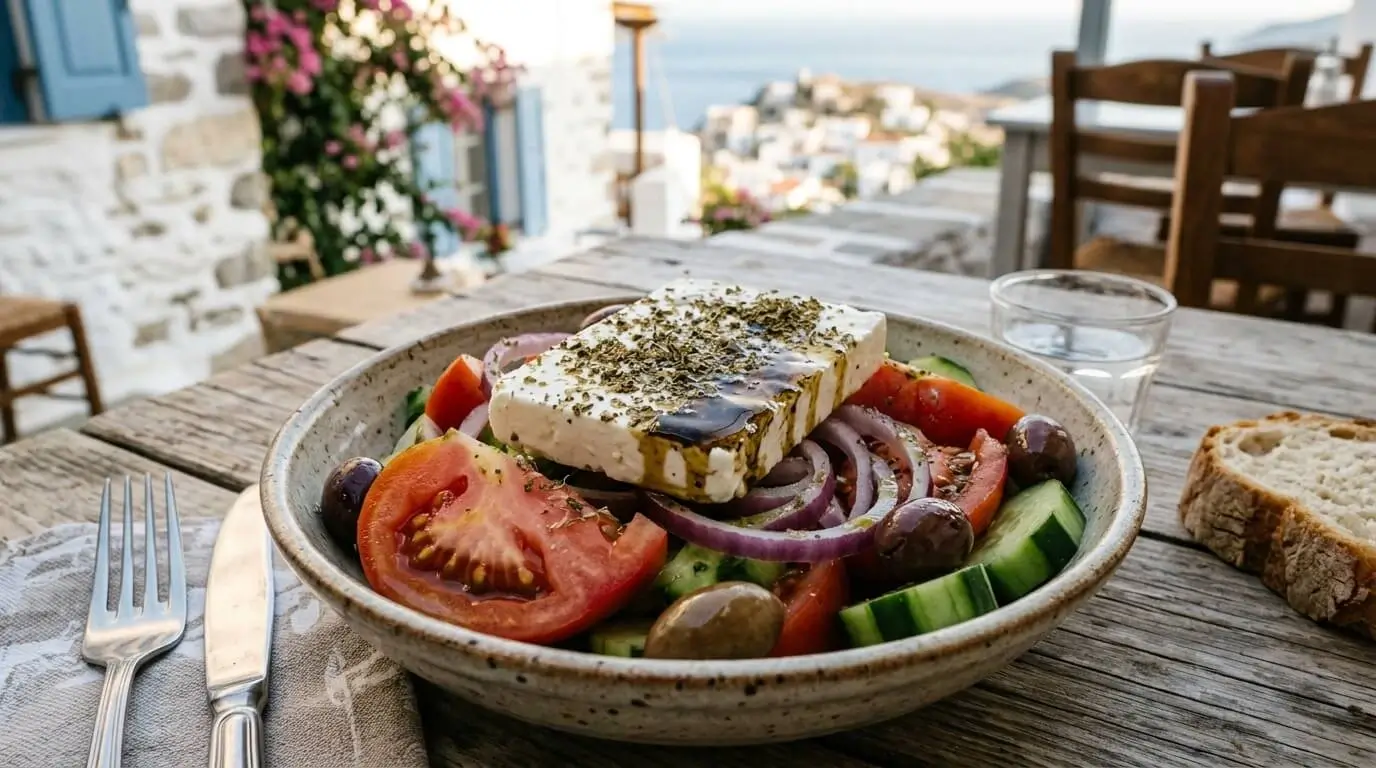
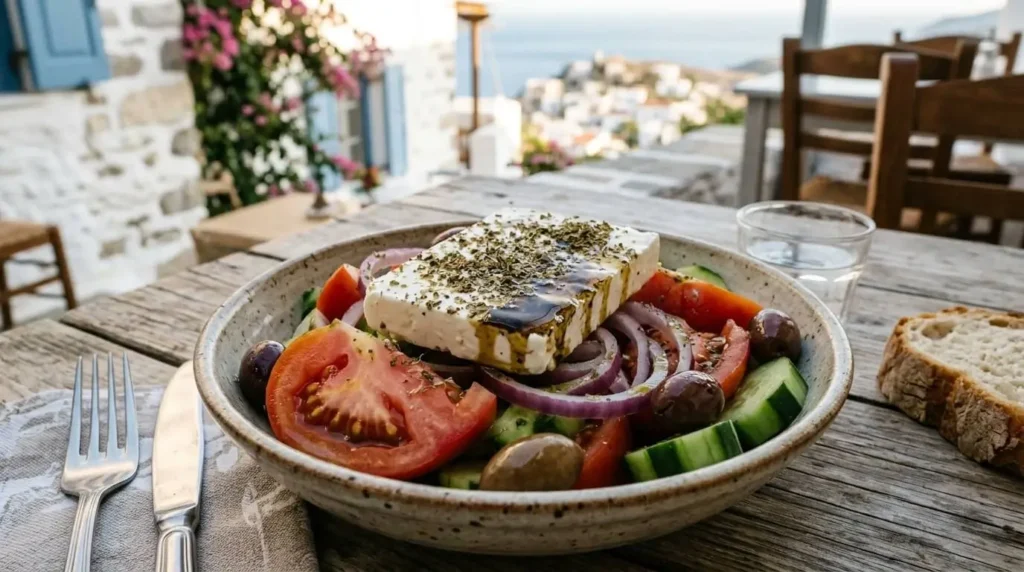
Most “Greek salad” recipes online are actually Americanized versions with lettuce and crumbled feta stirred into a vinaigrette. That’s why it’s the traditional Greek Village Salad or Horiatiki, built the way it’s actually served in Greece – large vegetable cuts, a slab of feta and a dressing that’s just good olive oil and oregano.
Quick Answer: What Is Greek Salad?
Authentic Greek salad – called Horiatiki or “village salad” – is a simple combination of ripe tomatoes, cucumber, red onion, Kalamata olives and a block of feta cheese, finished with extra-virgin olive oil and dried oregano. Furthermore, there’s no lettuce and no bottled dressing. Also, it’s ready in about 20 minutes and works as a light lunch, as a side dish or part of a Greek mezze spread.
Why You’ll Love This Greek Salad
This recipe sticks close to how Horiatiki is actually made in Greek homes and tavernas, without shortcuts that change the dish into something else.
- Authentic – no lettuce, no crumbled feta and no bottled dressing
- Ready in about 20 minutes, start to finish
- Naturally vegetarian or gluten-free
- Just a handful of fresh ingredients
- Beginner-friendly, with no cooking required
- Easy to scale up for a crowd and mezze spread
What Makes a Greek Salad Authentic?
Why It’s Called Horiatiki
“Horiatiki” translates to “village style” and that name is the whole philosophy of the dish. It was never meant to be dressed up – it’s a farmhouse salad built from whatever was ripe that day: so tomatoes, cucumbers, onions, olives and the local sheep’s-milk cheese. Furthermore, there’s no fancy technique to master, just good ingredients treated simply.
Does Authentic Greek Salad Have Lettuce?
No – and this is the detail that trips up most home cooks. Lettuce is common in American “Greek salad” at restaurants and delis, but it isn’t part of the traditional Horiatiki you’d be served in Greece. Because the vegetables are meant to hold their own texture and flavor without being bulked out with greens.
| Ingredient/Detail | Traditional Horiatiki | Common American Version |
| Lettuce | Not included | Often used as a base |
| Feta | Served as one block on top | Crumbled and mixed in |
| Olives | Whole Kalamata olives | Sometimes sliced or omitted |
| Dressing | Olive oil drizzled on and no emulsifying | Bottled vinaigrette and often emulsified |
| Vegetable cuts | Large, rustic wedges and chunks | Small or diced pieces |
Greek Salad Ingredients
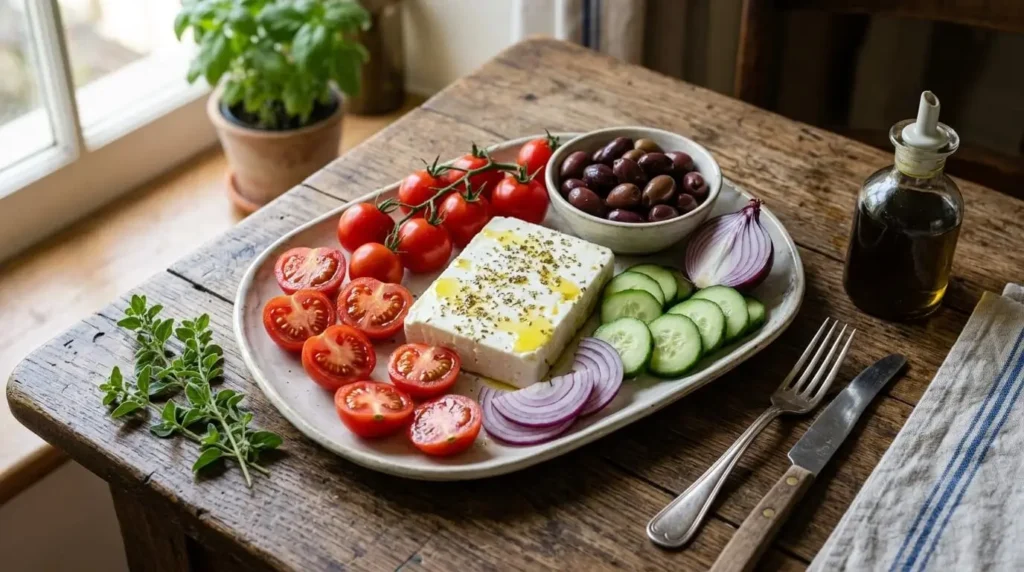
Every ingredient here earns its place – there’s nowhere for a mediocre one to hide. Feta cheese in the European Union’s protected Feta designation is traditionally made from sheep’s milk or a blend of sheep’s and goat’s milk, in specific regions of Greece. {target=”_blank”}
Tomatoes – Use the ripest, most flavorful tomatoes you can find. I’ve learned that underripe tomatoes can’t be rescued with extra dressing, so the salad simply tastes flat.
Cucumber – English or Persian cucumbers work best since they hold less water. Also, pat them dry after slicing to avoid a watery bowl.
Red onion – Thinly sliced for sharpness. If raw onion is too strong for your taste, a brief soak in cold water mellows it – not traditional, but a useful kitchen tip.
Kalamata olives – Left whole, never pitted or chopped, for texture and presentation.
Feta cheese – Served as a full block on top, but not crumbled in. This is one of the clearest markers of authenticity.
Oregano – Dried Greek oregano and sprinkled directly over the feta.
Olive oil – A good extra-virgin olive oil and generously drizzled – it’s essentially the entire dressing.
Red wine vinegar (optional) – Some regions add a small splash; that’s why others skip it entirely.
| Ingredient | Why It Matters | Best Substitute |
| Tomatoes | Carry most of the salad’s flavor. | Best in-season tomatoes available |
| Cucumber | Adds crunch without excess water | Persian cucumber |
| Feta | Defines the dish’s flavor and authenticity | Full-block feta, not pre-crumbled |
| Kalamata olives | Traditional briny contrast | Other Greek brine-cured black olives |
| Oregano | Traditional aromatic finish | Dried Mediterranean oregano |
Greek Salad Dressing
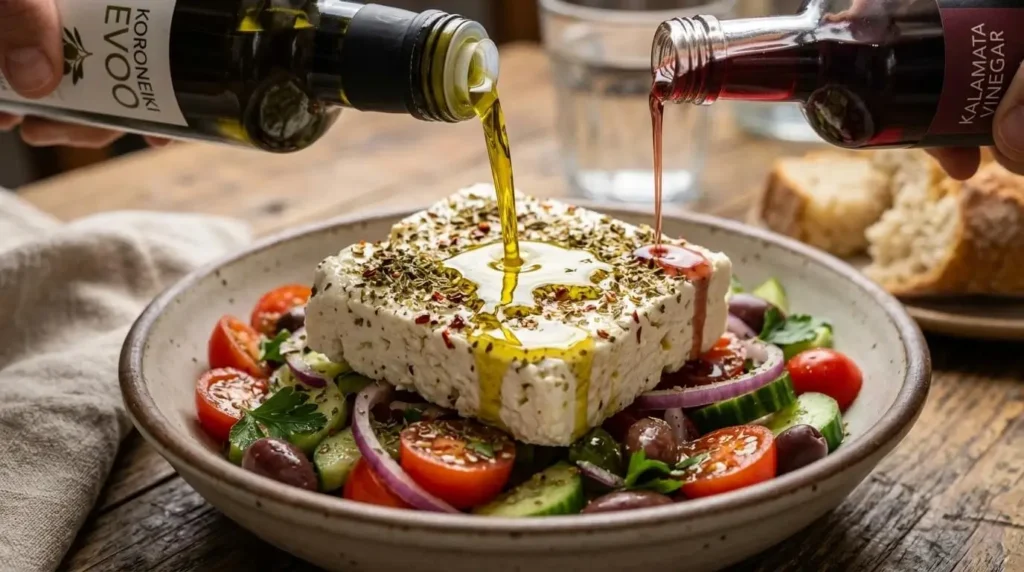
Traditional Horiatiki dressing isn’t really a “dressing” in the vinaigrette sense at all – it’s just good olive oil poured generously over the top, with oregano and salt. There’s no whisking, no emulsifying and no bottled Greek dressing involved.
Olive oil goes on first and does most of the work. A small splash of red wine vinegar is optional and regional – some households use it, others don’t. Bottled dressings tend to taste sharper and more uniform than fresh olive oil and they miss the simplicity that defines this dish.
Quick Dressing: 3 tbsp extra-virgin olive oil, 1 tbsp red wine vinegar (optional), 1 tsp dried oregano, sea salt to taste – drizzled over the finished salad, not tossed in a separate bowl.
How to Make Greek Salad
Quick Steps:
- Cut the vegetables into large or rustic pieces.
- Combine tomatoes, cucumber, onion and pepper in a bowl.
- Top with olives and a whole block of feta.
- Drizzle with olive oil and sprinkle with oregano.
- Serve immediately.
Wash and thoroughly dry every vegetable first – excess water dilutes the flavor and waters down the olive oil. Also cut the tomatoes into large wedges rather than small dice, because big pieces hold their juice and texture better.
Slice the cucumber into thick half-moons and the onion thinly, then combine everything with the optional bell pepper in a wide and shallow bowl. Additionally, scatter the olives over the top, then place the whole block of feta in the center rather than crumbling it in – this is what makes the presentation and flavor distinctly Horiatiki.
Finish with a generous drizzle of olive oil and a sprinkle of oregano directly over the feta; add vinegar if using and season lightly with salt. Serve right away, since salad doesn’t hold well once dressed.

Tips for the Best Greek Salad
Choosing Tomatoes
Ripe, in-season tomatoes matter more here than an expensive bottle of olive oil. If your tomatoes are pale or firm, this isn’t the week to make this salad.
Cutting Vegetables Properly
Large wedges and thick slices aren’t just for looks – they hold up better against the olive oil and stay firm instead of turning mushy.
When to Add Feta
Add the feta block right before serving, not while the vegetables are still being tossed, so it stays intact.
Don’t Overmix
Overmixing breaks down the tomatoes and crumbles the feta prematurely. A gentle combine is all this salad needs – the flavors come together on the plate, not in the bowl.
Chef Tip: Since feta and olives already bring plenty of salt, go light with added salt and taste before adjusting.
Common Mistakes and Troubleshooting
| Problem | Cause | Fix |
| Watery salad | Cucumbers and tomatoes not dried after washing | Pat vegetables dry before assembling. |
| Bland flavor | Underripe or out-of-season tomatoes | Use the ripest tomatoes available |
| Broken feta | Feta crumbled or tossed too roughly | Keep feta as a block, and add gently on top. |
| Overdressed salad | Too much olive oil or overmixing | Drizzle just before serving, and mix gently. |
| Bitter onion | Onion too sharp for raw use | Soak sliced onion briefly in cold water. |
Variations and Ingredient Substitutions
Authentic regional variations: Some regions of Greece add green bell pepper or capers; others skip the vinegar entirely and rely solely on olive oil. Therefore, coastal areas sometimes add a small amount of caper leaves for extra brine.
Practical US grocery substitutions: If Greek feta isn’t available, a good-quality block feta from any Mediterranean grocer is the next best option – just avoid pre-crumbled feta, which is drier and less creamy, because Kalamata olives can be swapped for another Greek brine-cured black olive if needed.
| If You Can’t Find… | Use… |
| Greek feta (block) | Bulgarian or French sheep’s-milk feta block |
| Kalamata olives | Other Greek brine-cured black olives |
| Dried Greek oregano | Mediterranean dried oregano |
| Vine-ripened tomatoes | Best available ripe, in-season tomatoes |
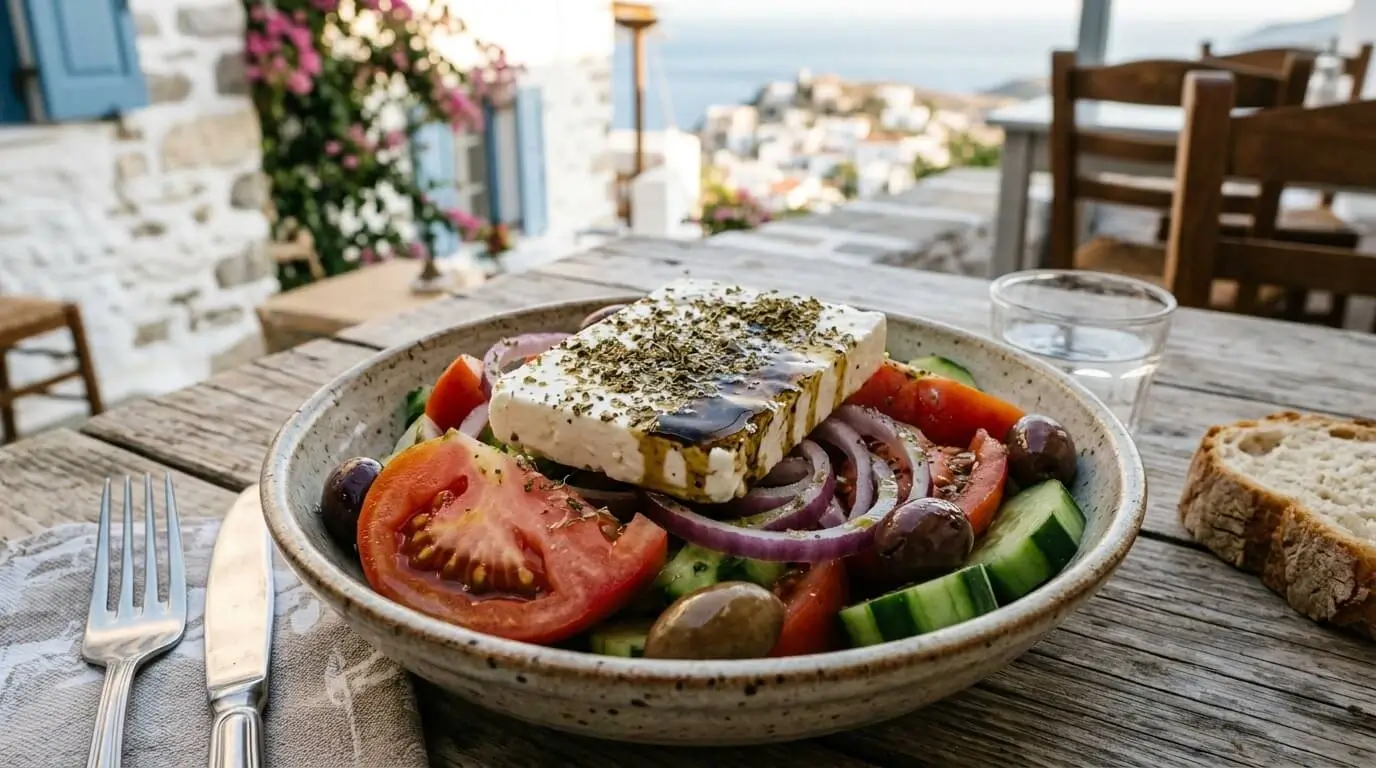
Authentic Greek Salad (Horiatiki)
Ingredients
Method
- Wash and thoroughly dry all vegetables.
- Cut tomatoes into large wedges.
- Slice cucumber into thick half-moons.
- Thinly slice the onion.
- Combine tomatoes, cucumber, onion and pepper in a large bowl.
- Scatter olives over the vegetables.
- Place the block of feta on top.
- Drizzle with olive oil.
- Add vinegar if using.
- Sprinkle oregano over the feta.
- Season lightly with salt.
- Serve immediately without excessive tossing.
Notes
- Choose the ripest tomatoes you can find – this matters more than any other ingredient.
- Block feta is traditional; pre-crumbled feta is drier and less authentic in presentation.
- Lettuce is not part of authentic Horiatiki.
- Vinegar is optional and varies by region.
- Serve immediately for the best texture.
- Calories: ~260
- Protein: ~7 g
- Fat: ~22 g
- Carbohydrates: ~10 g
- Fiber: ~3 g
- Sodium: varies by feta and olives
What to Serve with Greek Salad
As a Light Lunch
On its own with warm pita bread and horiatiki, it makes a satisfying light meal.
As a Side Dish
It pairs naturally with grilled chicken, grilled fish or lamb – the acidity and freshness balance richer or smokier flavors.
As Part of a Greek Mezze Spread
Serve it alongside other small plates for a shared and mezze-style meal.
Complete Meal Ideas:
- Greek salad, grilled fish and pita bread
- Greek salad, grilled lamb and tzatziki
- Greek salad as part of a full mezze spread

Browse more ideas on our Browse all recipes page.
Make Ahead, Storage & Leftovers
This salad is genuinely best made fresh – the vegetables and feta lose their texture once dressed and refrigerated. That’s why you can chop the tomatoes, cucumber and onion ahead of time and store them separately in the refrigerator.
Add the feta, olive oil and oregano only just before serving. Store any leftovers in the refrigerator and use them within a couple of days, keeping perishable foods refrigerated promptly after serving.{target=”_blank”} Freezing isn’t recommended – the vegetables turn watery and limp once thawed.
| Situation | Recommendation |
| Prep ahead. | Yes – chop vegetables in advance. |
| Dress ahead. | No – add oil and feta just before serving. |
| Refrigerate leftovers. | Yes, within a couple of days |
| Freeze | No |
Frequently Asked Questions
What is a traditional Greek salad made of?
Traditional Greek salad or horiatiki, is made with ripe tomatoes, cucumber, red onion, kalamata olives, a block of feta cheese, olive oil and oregano. It doesn’t include lettuce or a separate bottled dressing.
Does authentic Greek salad have lettuce?
No. Lettuce is common in American-style Greek salads served at restaurants, because it isn’t part of the traditional Horiatiki made in Greek homes and tavernas.
What dressing is traditionally used on Greek salad?
There isn’t a separate dressing in the vinaigrette sense – extra-virgin olive oil is drizzled generously over the top, along with oregano and a little salt. Also, vinegar is optional and regional.
Are Greek salads healthy?
Greek salad is built from vegetables, olive oil and feta cheese. Olive oil is a key part of the Mediterranean dietary pattern often associated with balanced eating, though feta and olives do add sodium, so portion size matters if you’re watching salt intake.
Can I make Greek salad ahead of time?
You can chop the vegetables ahead and store them separately, but wait to add the feta, olive oil and oregano until just before serving to keep the texture right.
Can I use bottled Greek dressing?
You can, but it won’t taste the same as fresh olive oil and oregano, which is what defines the traditional flavor of Horiatiki.
Can I use crumbled feta instead of a block?
You can for convenience, but a whole block of feta is the traditional presentation and holds its texture better than pre-crumbled feta, which tends to be drier.
What olives are best for Greek salad?
Kalamata olives are the traditional choice for their brine and richness. That’s why other Greek brine-cured black olives work as a substitute if Kalamatas aren’t available.
Final Thoughts
If you’ve only had the restaurant version of Greek salad, the authentic Horiatiki is worth trying at least once. Furthermore, it’s simpler than most recipes suggest – a handful of good ingredients and treated with a little restraint. Once you’ve made it this way, it’s hard to go back to lettuce and bottled dressing.
For more dishes from the region, explore our Greek recipes collection or head back to the Mediterranean Cuisines home.
[IMAGE 1: greek-salad-horiatiki.jpg | Authentic Greek salad with feta, tomatoes, cucumber and Kalamata olives | Greek Salad (Horiatiki) | Traditional Greek village salad prepared with fresh Mediterranean ingredients. | Hero image showcasing the finished authentic Greek salad served family-style.]
[IMAGE 2: greek-salad-ingredients.jpg | Greek salad ingredients for authentic Horiatiki | Greek Salad Ingredients | Everything needed for a traditional Horiatiki. | Ingredient overview before preparation.]
[IMAGE 4: greek-salad-dressing.jpg | Traditional Greek salad dressing with olive oil and oregano | Traditional Greek Dressing | Authentic dressing is intentionally simple. | Shows the final seasoning before serving.]
(Images 3 and 5 are placed inline above in their assigned sections.)