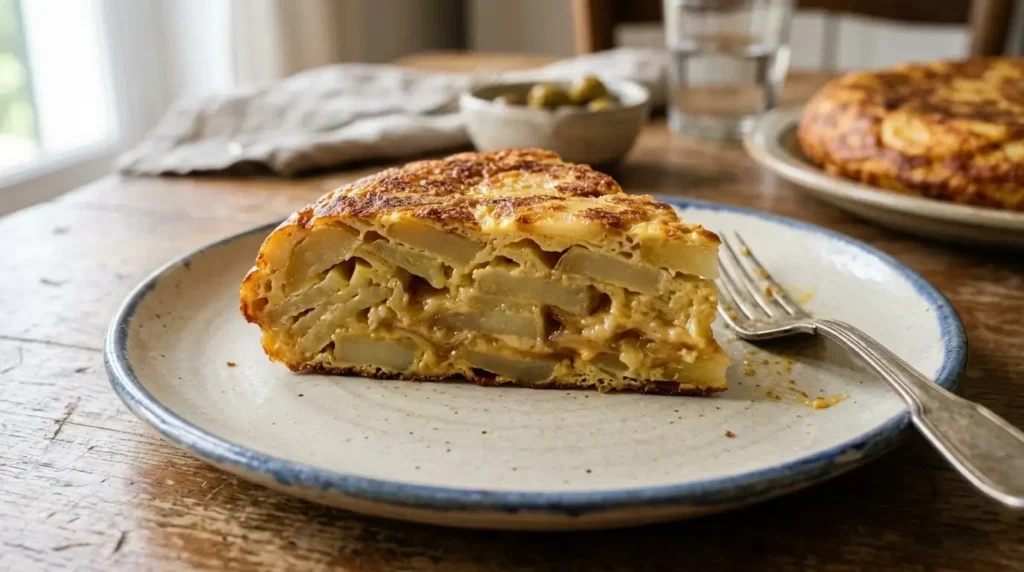
Spanish tortilla – tortilla española or tortilla de patatas – is a thick, round omelette built from tender potatoes, eggs and good olive oil, cooked slowly in a skillet rather than baked or folded like a French omelette. Moreover, this Spanish tortilla recipe walks through the traditional technique step by step, including the part most home cooks dread: the flip. Also, expect a reliable method, honest timing and clear troubleshooting rather than a rushed version that falls apart in the pan.
Quick Answer: What Is a Spanish Tortilla?
A Spanish tortilla is a thick potato-and-egg omelette from Spain, made by gently cooking sliced or cubed potatoes in olive oil, combining them with beaten eggs and cooking the mixture in a skillet until it holds its round shape. However, it’s typically finished with a confident flip so both sides set evenly. Because Spanish tortilla is usually cut into wedges and served warm or at room temperature, often as tapas, a light lunch or part of a larger spread – not as a bread or wrap, which is what “tortilla” refers to in Mexican cooking.
What Is a Traditional Spanish Tortilla?
Tortilla española – also called tortilla de patatas – is made from just a handful of ingredients: potatoes, eggs, olive oil and salt. Because the potatoes aren’t a garnish here; they’re the bulk of the dish, cooked gently until tender and then bound together by beaten egg into a dense, custardy interior. Furthermore, olive oil isn’t optional flavoring – it’s the cooking medium the potatoes are gently poached in before they ever meet the eggs, which is part of what gives the finished tortilla its characteristic texture.
Calling it a “Spanish omelet” isn’t wrong, but it undersells what’s actually happening. A French-style omelette is thin, fast and egg-forward. Because a Spanish tortilla is thick, slower to make and potato-forward, with the eggs acting more as a binder than the main event. But that distinction matters for anyone expecting a quick five-minute egg dish.
Spanish Tortilla vs. Mexican Tortilla
These two dishes share a name and almost nothing else, which is a common point of confusion for US readers. Moreover, a Spanish tortilla is a potato-and-egg omelette; a Mexican tortilla is a flatbread made from corn (tortilla de maíz) or wheat (tortilla de harina) and used as a wrap or base for other foods, not eaten as a standalone dish.
| Spanish tortilla | Mexican tortilla |
| Egg-and-potato dish. | Flatbread. |
| Tortilla española / tortilla de patatas. | Tortilla de maíz or de harina. |
| Cooked as a thick, round omelette. | Pressed or rolled thin, used as bread/wrap. |
What Makes a Spanish Tortilla Traditional?
The traditional foundation is narrow and specific: potatoes, eggs, extra-virgin olive oil and salt. Because onion is where recipes genuinely diverge – it’s a well-known point of debate among home cooks and regional families, not a settled rule and this brief treats it as such rather than declaring one version the “real” one.
Beyond ingredients, what makes a tortilla read as traditional is the process. However, the potatoes are cooked low and slow in oil until they’re fully tender – closer to confit than to home fries – rather than browned and crisped. That mixture is combined with beaten eggs and cooked in a well-oiled skillet, shaped into a thick, even round rather than spread thin. But the tortilla is then flipped, typically with the help of a plate, so it cooks through evenly on both sides and holds a firm outer set with a moist, tender interior. Hence, oven-baked versions and additions like chorizo, peppers or cheese exist, but they’re reasonably treated as adaptations layered on top of this base rather than the traditional dish itself.
Onion or No Onion?
Some cooks consider onion essential for the sweetness and moisture it adds; others keep the recipe to potatoes, eggs, oil and salt for a simpler, more classic profile. Therefore, both approaches are common in home kitchens and neither should be presented as the single authentic version without stronger sourcing than a recipe brief can responsibly claim.
| If you want… | Choose… |
| A simple, classic potato-and-egg profile. | No onion. |
| A sweeter, softer variation. | Onion. |
| A version based on a specific family or regional tradition. | Follow that tradition. |
This recipe is written as a [tested version: with onion / without onion – confirm before publishing] and the ingredient list below reflects that choice.
Spanish Tortilla Ingredients
The ingredient list is short on purpose. However, each one does real work in the finished dish, so substitutions or additions change the texture more than you’d expect from a “just eggs and potatoes” dish.
| Ingredient | Role |
| Potatoes | Main body and texture. |
| Eggs | Binder and custard-like structure. |
| Olive oil | Cooking medium and flavor. |
| Salt | Seasoning. |
| Onion | Optional variation, depending on the chosen version. |
Waxy or all-purpose potatoes that hold their shape when gently cooked work best; very starchy baking potatoes tend to break down too much. Also, use enough olive oil to fully submerge or generously coat the potato slices while they cook – this isn’t a dish where you shallow-fry with a thin film of oil.
How to Make Spanish Tortilla
Prepare the Potatoes
Peel the potatoes and cut them into thin, even slices or small cubes – consistency matters more than the exact shape, because uneven pieces cook unevenly. Further, aim for pieces thin enough to become fully tender in the time it takes the oil around them to gently soften them, not brown them. Hence, uneven cutting is one of the most common reasons a home tortilla ends up with a mix of mushy and undercooked potato in the same bite.
Cook the Potatoes
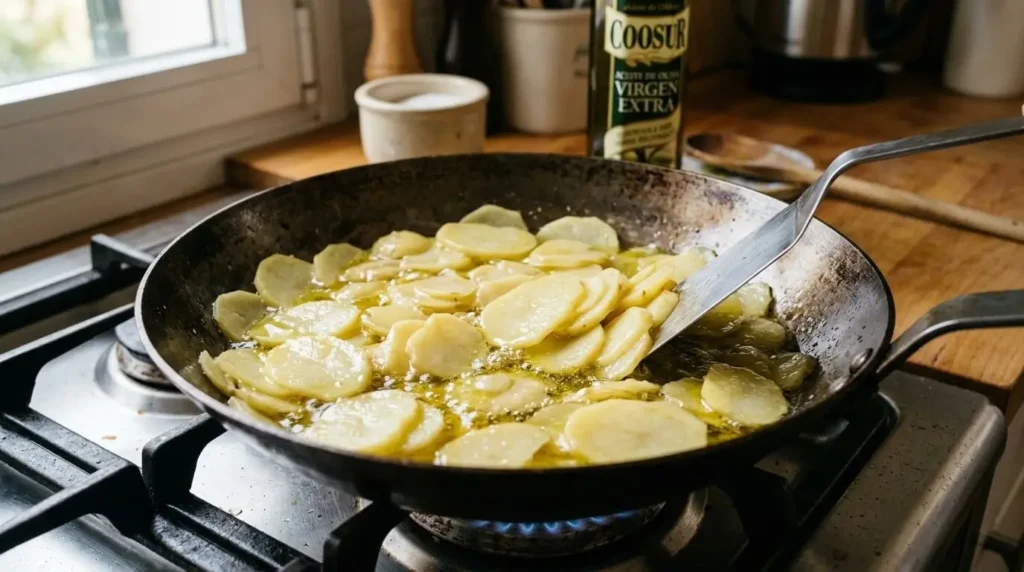
Warm a generous amount of olive oil in a wide skillet over medium-low heat, then add the potatoes (and onion, if using). Because the goal is gentle, steady cooking – closer to poaching than frying – so the potatoes soften all the way through without picking up much color. Then stir occasionally and adjust the heat down if you see real browning starting. But the potatoes are ready when a piece breaks apart easily under light pressure from a fork, with no firm core.
Combine the Potatoes and Eggs
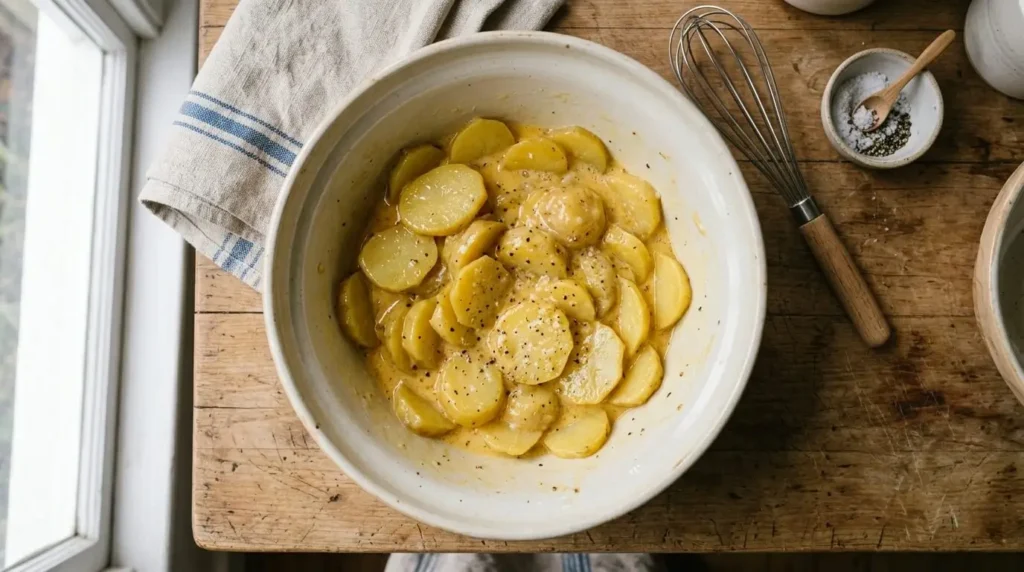
Drain the potatoes well, reserving the oil and let them cool slightly. Therefore, beat the eggs in a large bowl with a pinch of salt, then fold in the warm potatoes rather than stirring vigorously – you want the potatoes coated in egg, not broken down into mush. Furthermore, letting the mixture sit for a few minutes lets the potatoes absorb some of the egg, which helps the tortilla hold together.
Shape and Cook the Tortilla
Return a couple of tablespoons of the reserved oil to a clean, well-seasoned or nonstick skillet over medium heat. Then pour in the potato-and-egg mixture and immediately use a spatula to press it into an even, compact round, tucking the edges in as they start to set. Also, reduce the heat slightly once the pan is hot – you want the bottom to set without the top staying completely raw. The tortilla is ready to flip once the edges are set and the center is just barely loose.
Flip the Spanish Tortilla
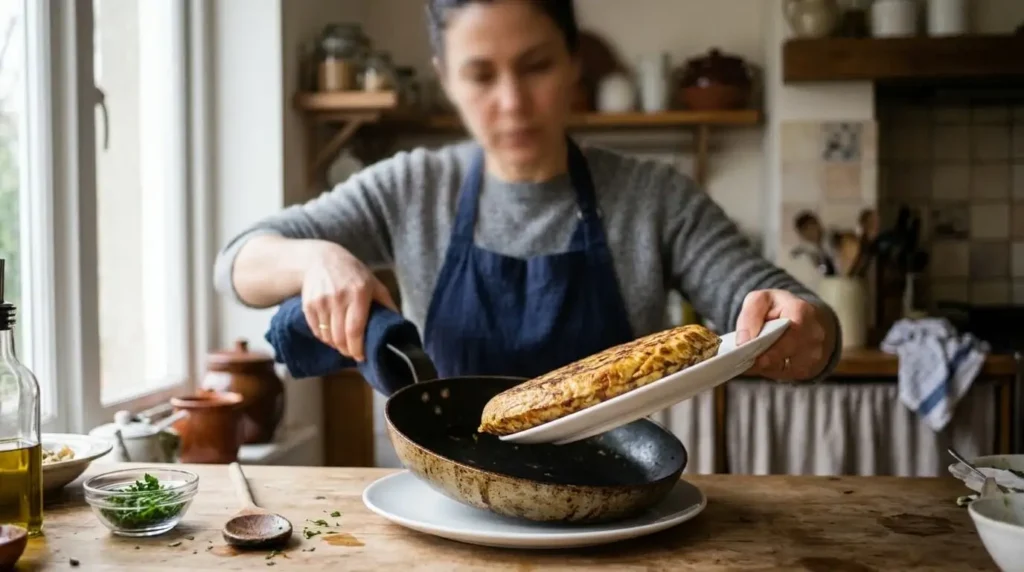
Choose a flat plate slightly larger than your skillet. Also place it firmly over the pan, then – holding the plate and pan handle together with both hands – invert the pan in one confident motion so the tortilla drops onto the plate, cooked side up. But slide the tortilla back into the skillet, uncooked side down, tucking the edges back into a round shape as needed. Further work over the stovetop when you flip and keep your hands and forearms clear of the pan’s edge; hot oil can splash during the turn.
How to Know When Spanish Tortilla Is Done
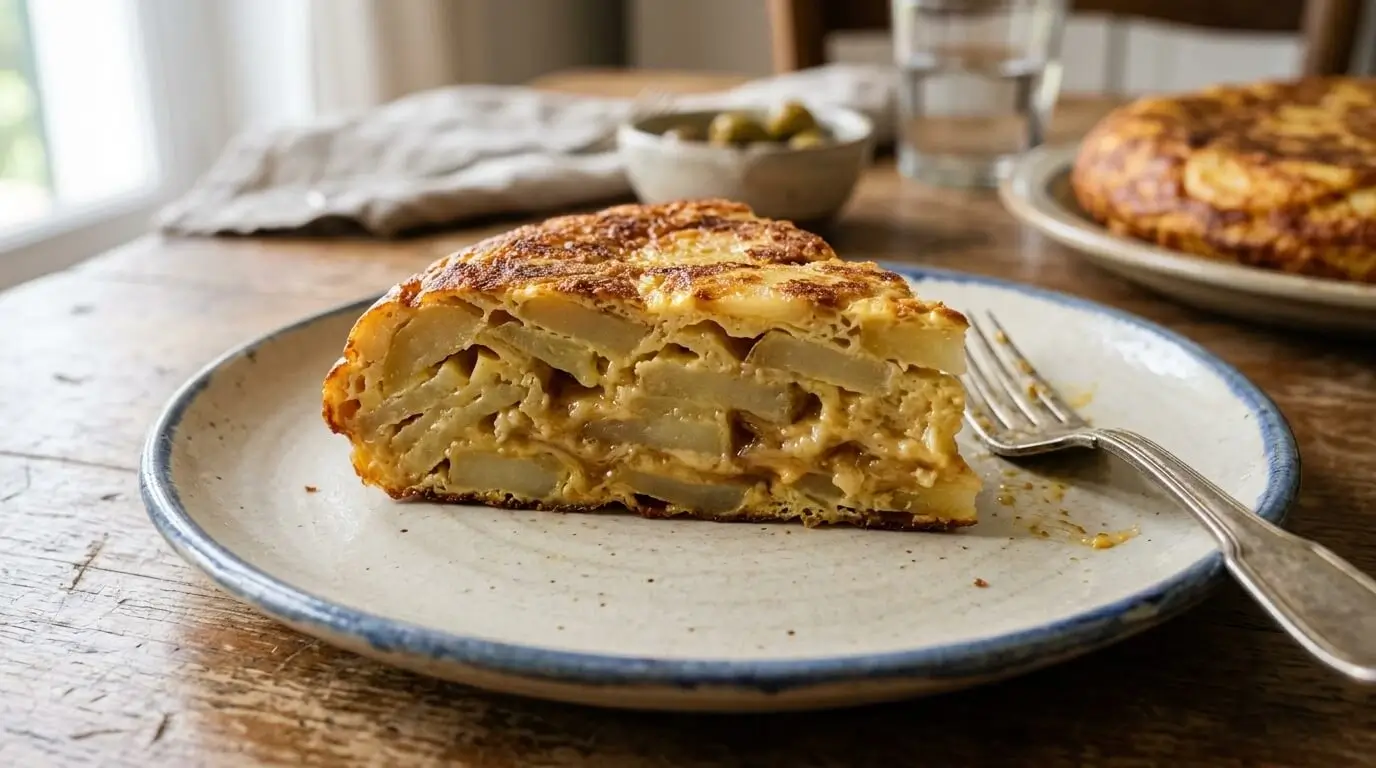
A well-made tortilla has a set, lightly golden exterior and a moist, tender interior – not raw and runny, but not dry and crumbly either. Moreover, press the center gently with a fingertip or the back of a spoon: it should feel firm at the edges and just slightly springy toward the middle, without liquid egg pooling around the edges when the tortilla is tilted.
| Desired result | Visual cue | Cooking approach |
| Softer center | The center remains tender and moist. | Shorter final cooking time. |
| Fully set center | The center is firm throughout. | Longer final cooking time. |
| Beginner-safe set | The center is more thoroughly set. | Slightly longer final cooking time. |
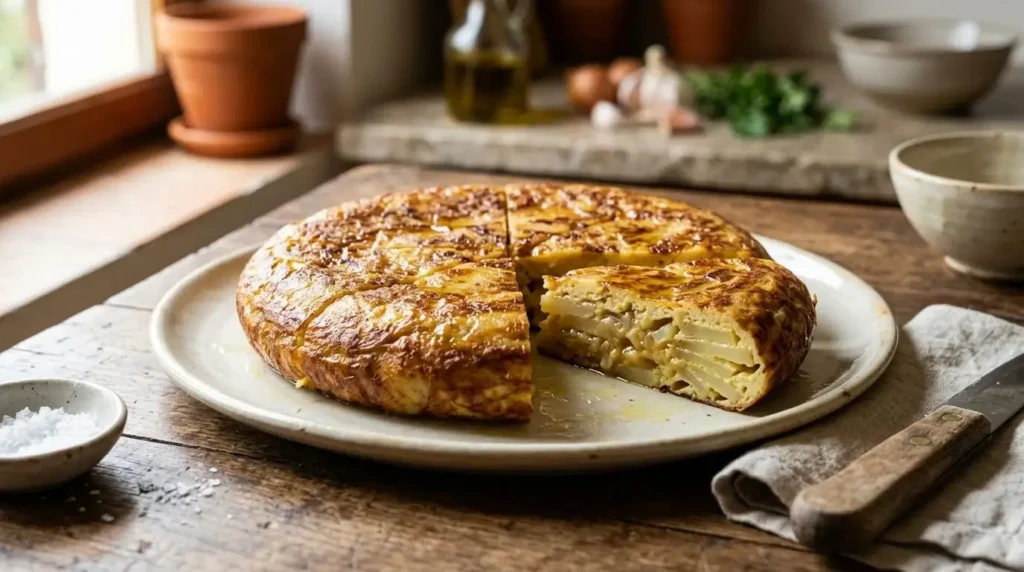
If you prefer a very soft center, keep in mind that fully cooked eggs are the safer choice; the USDA lists 160°F as the minimum safe internal temperature for egg dishes generally, so if you’re unsure, cook a little longer rather than serving an undercooked center.
How Long Does Spanish Tortilla Take?
[Active time: TESTED VALUE] | Cook time: [TESTED VALUE] | Total time: [TESTED VALUE]
Spanish tortilla is often billed online as a fast dish, but that undersells what actually goes into it: slicing and gently cooking the potatoes until fully tender takes real stovetop time on its own, separate from the few minutes it takes to cook the tortilla itself once it’s in the pan. Because the total time here should account for the full potato-cooking and tortilla-forming process, not just the final few minutes in the skillet – final numbers will be confirmed once this recipe is tested and timed in the kitchen.
Spanish Tortilla vs. Frittata
Both are egg dishes cooked in a skillet, which is why they’re often confused, but the structure and technique differ. Moreover, a frittata is Italian, egg-forward and typically finished under a broiler or in the oven with mix-ins folded through the eggs. Because a Spanish tortilla is built around potatoes first, cooked entirely on the stovetop and shaped into a distinct thick round rather than left loose in the pan.
| Feature | Spanish Tortilla | Frittata |
| Culinary origin | Spain. | Italy. |
| Core structure | Potato and egg. | Egg-base. |
| Typical cooking approach | Pan-shaped, flipped on the stovetop. | Often finished in the oven or under a broiler. |
| Texture | Dense, layered potato-and-egg structure. | More egg-forward. |
| Typical additions | Relatively restrained. | Often includes vegetables, cheese and herbs. |
Common Spanish Tortilla Mistakes
| Problem | Likely Cause | Fix |
| Tortilla sticks to the pan. | Not enough oil or the pan not properly heated. | Use plenty of oil and make sure the pan is hot before adding the mixture. |
| Breaks while flipping. | The first side wasn’t set enough, or the plate wasn’t secured firmly. | Wait until the edges are fully set and hold the plate tightly against the pan during the flip. |
| Dry cente.r | Overcooked after flipping. | Reduce the final cooking time and check doneness earlier. |
| Raw or runny center. | Undercooked or flipped too early. | Continue cooking gently until the center firms up. |
| Potatoes remain firm. | Potatoes weren’t cooked long enough before being combined with eggs. | Cook potatoes until they break apart easily with a fork before mixing them with the eggs. |
| Uneven or misshapen tortilla. | The mixture wasn’t pressed and shaped as it cooked. | Use a spatula to tuck the edges in and compact the round while the first side sets. |
Spanish Tortilla (Potato & Egg Omelette)
Ingredients
Method
Notes
- Potato texture: potatoes should break apart easily under light fork pressure – about 15-18 minutes of gentle cooking – before combining with the eggs.
- Pan: an 8-inch nonstick or well-seasoned skillet gives the right thickness; sizing up changes the flip and the cook time.
- Flipping: use a flat plate slightly wider than the skillet and hold plate and pan handle together firmly during the turn.
- Doneness: this version targets a just-set, tender center rather than fully firm throughout; cook longer if you prefer it more set.
- Onion: written here with onion; omit for the classic no-onion version – both are traditional.
- Serving: best warm or at room temperature; also good chilled the next day.
- Food safety: cooked egg dishes should reach a minimum internal temperature of 160°F per USDA guidance; if you prefer a very soft center, be aware a fully undercooked egg mixture isn’t considered food-safe.
Substitutions for US Home Cooks
Most of this recipe’s ingredients are already easy to find in a typical US grocery store, so there’s not much that genuinely needs substituting. However, waxy or all-purpose potatoes (like Yukon Gold) work reliably; very starchy russets can fall apart more than you’d want. Moreover, extra-virgin olive oil is the traditional cooking fat and there’s no need to swap it out for something else. Hence, Onion is simply a matter of the version you’re making, not a substitution issue.
| Traditional ingredient | US-friendly option | Effect on authenticity |
| Waxy or all-purpose potatoes. | Yukon Gold potatoes. | None – widely available and traditional-friendly. |
| Extra-virgin olive oil. | No substitution needed. | Standard, already accessible. |
| Onion (if used). | Yellow or white onion. | None – matches the version you’re following. |
Storage, Reheating & Serving
Refrigerate leftover Spanish tortilla in an airtight container once it has cooled and use it within a few days. Moreover, the USDA’s food safety guidance recommends refrigerating cooked egg dishes promptly and using leftovers within 3-4 days and that perishable food shouldn’t sit at room temperature for more than about 2 hours. Then reheat gently in a skillet or the microwave or serve straight from the fridge – the texture holds up reasonably well cold, which is part of why this dish works for make-ahead meals. But freezing tends to change the potato texture noticeably, so it’s better suited to short-term refrigerator storage than to the freezer.
How to Serve Spanish Tortilla
Spanish tortilla is commonly cut into wedges and served warm, at room temperature or chilled – all three are legitimate depending on the setting. Because it works as tapas alongside other small dishes, as a light lunch with a simple salad or as part of a larger spread. Hence, there’s no single required accompaniment; a crusty piece of bread and something acidic, like a simple tomato salad, are enough to round it out without competing with it.
Is Spanish Tortilla Healthy?
Spanish tortilla isn’t inherently “healthy” or “unhealthy” on its own – like most dishes, that depends on portion size and how it fits into the rest of what you eat. Moreover, eggs contribute protein, potatoes contribute carbohydrates and olive oil contributes fat; the total calorie count depends heavily on how much oil is used and how large a slice you’re eating. However, it’s naturally vegetarian and it can be gluten-free depending on the exact ingredients used, since the core recipe doesn’t call for flour.
Spanish tortilla can fit into a Mediterranean-style eating pattern, which the Harvard T.H. Chan School of Public Health describes as emphasizing vegetables, fruits, whole grains, legumes, nuts, olive oil, and fish, with moderate amounts of other animal foods – but Harvard is also clear that the health evidence concerns the overall dietary pattern, not any single dish. Since one recipe shouldn’t be treated as proof of a health outcome on its own.
Frequently Asked Questions
What is a Spanish tortilla called?
It’s called tortilla española or tortilla de patatas in Spanish. But in English-language recipes, it’s often labeled a “Spanish omelet” or “Spanish tortilla,” but those are translations rather than separate dishes – all of these terms describe the same potato-and-egg omelette.
What’s in a traditional Spanish tortilla?
The traditional base is potatoes, eggs, extra-virgin olive oil and salt. Furthermore, onion is a common but genuinely debated addition – some cooks include it for sweetness and moisture, others keep the recipe to just potatoes, eggs, oil and salt.
Is a Spanish tortilla the same as a Mexican tortilla?
No. A Spanish tortilla is a thick potato-and-egg omelette, while a Mexican tortilla is a thin flatbread made from corn or wheat and used as a wrap or base for other foods. Hence, they share a name but aren’t related dishes.
Is Spanish tortilla the same as a frittata?
They’re similar but not the same. Because both are skillet-cooked egg dishes, however, a Spanish tortilla is built around potatoes and cooked entirely on the stovetop with a flip, while a frittata is more egg-forward and often finished in the oven or under a broiler.
Can I make Spanish tortilla in the oven?
An oven method exists and can work as a shortcut, particularly for the flip-averse, but the traditional method cooks the tortilla entirely on the stovetop with a manual flip. Then treat an oven version as a modern adaptation rather than the classic technique.
How do you know when Spanish tortilla is done?
The exterior should be set and lightly golden and the center should feel firm at the edges with just a slight give in the middle – not liquid and not dry and crumbly. Further, press the center gently to check before serving.
Can Spanish tortilla be eaten cold?
Yes. Spanish tortilla is commonly served warm, at room temperature or chilled straight from the refrigerator and all three are traditional serving styles depending on the occasion.
How healthy is Spanish tortilla?
It depends on portion size and how much oil is used. Because eggs supply protein, potatoes supply carbohydrates and olive oil supplies fat, the dish can fit into a Mediterranean-style eating pattern, but no single recipe should be treated as inherently healthy on its own.
Internal Links Used
- Mediterranean recipes — related recipes / serving section
- Mediterranean cuisines by region — origin/context section
- Mediterranean diet — nutrition section