Menemen is a Turkish egg dish built around a base of cooked-down tomatoes and green peppers, finished by gently folding in eggs until they’re softly set – not scrambled hard and dry the way you’d make eggs for a diner breakfast. However, this menemen recipe walks through the technique that actually matters (tomato reduction, gentle egg folding), settles the onion debate honestly and gives you real timing instead of an optimistic 10-minute promise.

Quick Answer: What Is Menemen?
Quick Answer: Menemen is a Turkish dish in which eggs are gently scrambled and folded into a cooked mixture of tomatoes and green peppers, rather than fried whole or cooked separately. That’s why the eggs and vegetables become one soft, moist mixture, seasoned simply and served hot straight from the pan with crusty bread for scooping. Moreover, it’s typically eaten for breakfast, though it also shows up at lunch or a light dinner.
That soft, folded-in egg texture is what separates real Turkish menemen from a basic “eggs with tomatoes” recipe – and it’s the single detail most US recipes get wrong.
What Makes This Menemen Recipe Different?
Most menemen recipes online treat it like a simple skillet scramble: chop, cook, done. Because this one focuses on the three things that actually determine whether your menemen turns out right. First, the egg technique – eggs are folded gently into the tomato-pepper base, then pulled off the heat while still glossy, not cooked until dry. Second, honesty about ingredients – onion, cheese and extra spices are real but optional variations, not universal requirements and this recipe says so plainly. Hence, third, realistic timing: tomatoes take time to reduce properly and rushing that step is the most common reason menemen turns out watery.
What Goes Into Turkish Menemen?

Core Ingredients
Menemen’s ingredient list is short, so each one has to earn its place. Also, eggs provide the structure and richness once folded into the vegetables – use good, fresh eggs since there’s nowhere for off- flavors to hide. Then tomatoes form the base; ripe, juicy tomatoes cook down into a thick, slightly sweet-tart sauce that the eggs fold into. Because green peppers add a mild, slightly grassy sharpness that balances the tomato’s sweetness. Moreover, olive oil is the cooking fat and carries flavor throughout – a good extra-virgin olive oil makes a real difference here. Hence, salt and black pepper are the baseline seasoning; everything else is optional.
Turkish Peppers and US Substitutions
Traditional Turkish menemen uses a mild, thin-skinned green pepper (often called sivri biber or Turkish long green pepper) that isn’t commonly stocked in US grocery stores. Therefore, rather than pretending a substitute is identical, it’s worth naming solid alternatives: shishito peppers, Padrón peppers and Chinese long green peppers all have a similar mild, slightly grassy profile and work well in this recipe. Furthermore, none of these is a perfect match – Turkish peppers have their own specific character – but they get you close enough for a genuinely satisfying result without a specialty grocery trip.
Traditional Menemen: Onion or No Onion?
Is Onion Traditional in Menemen?
This is one of the most-argued points about menemen and the honest answer is: both versions are legitimate. Because some households and regions build menemen on a base of softened onion along with the peppers and tomatoes, others – especially breakfast versions – skip onion entirely and let the tomatoes and peppers carry the dish on their own. Neither is more “authentically Turkish” than the other; it’s closer to a household preference than a fixed rule. However, this recipe uses the no-onion baseline to keep the ingredient list focused and the cook time realistic, but adding a small amount of finely chopped onion with the peppers is a reasonable, well-documented variation if you prefer it.
Traditional Ingredients vs. Common Variations
| Ingredient/addition | Baseline role | Variation status |
| Tomatoes | Core. | – |
| Green peppers | Core. | – |
| Eggs | Core. | – |
| Onion | Not in this baseline. | Common variation, especially outside breakfast. |
| Cheese | Not in this baseline. | Documented in regional versions (see below). |
| Extra seasonings | Optional. | Household preference. |
Where Does Menemen Come From?
Menemen takes its name from the town of Menemen, near İzmir on Turkey’s Aegean coast and the dish is closely tied to that region’s culinary identity, according to the İzmir Provincial Directorate of Culture and Tourism. Therefore, even the official regional account presents more than one narrative about the dish’s exact origin, so it’s more accurate to describe menemen as regionally associated with the Aegean coast than to claim a single, definitive founding story.
Documented Regional Variations
A few local versions are genuinely documented rather than assumed. Because Çakallı menemen, associated with the Samsun region, is made with kaşar cheese and often with pastırma folded into the mixture. But Isparta kuru biberli menemen, from the Isparta region, is made with dried red peppers instead of fresh green ones. That’s why these are real, named regional preparations – but they’re specific local dishes, not evidence of a broader, catalogued “menemen belt” across Turkey, so it’s worth treating them as individual variations rather than a formal regional taxonomy.
How to Make Menemen
Cook the Peppers and Aromatics
Start the sliced green peppers in warm olive oil over medium heat. But you’re looking for them to soften and turn fragrant – a couple of minutes of steady cooking, stirring occasionally. Hence, don’t rush this by cranking the heat; scorched peppers turn bitter and that bitterness carries through the whole dish.
Cook Down the Tomatoes
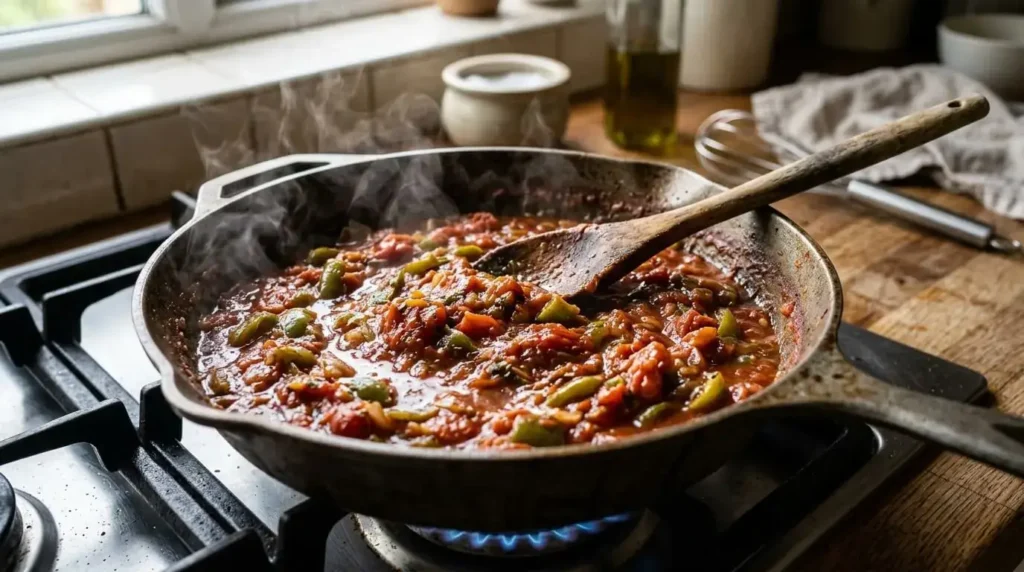
This is the step that decides whether your menemen turns out right. Also, add the chopped tomatoes and let them break down and reduce until the mixture is thick and spoonable, with no pooling liquid at the edges of the pan. However, this usually takes longer than people expect – tomatoes hold a lot of water and that water has to cook off before the eggs go in. Then if you add eggs to a watery tomato base, you’ll end up with a thin, soupy dish instead of a cohesive one.
Add and Gently Scramble the Eggs
Once the tomato base is thick, lower the heat – this part happens gently or not at all. Then pour in the lightly beaten eggs and fold them through the vegetables with a spoon or spatula, more like folding batter than whisking a scramble. But keep the heat low and the motion slow. Because the goal is eggs that set gradually as they mix with the hot tomatoes and peppers, not eggs that seize up in patches from a too-hot pan.
How Soft Should Menemen Be?
Pull the pan off the heat while the eggs still look slightly glossy and a touch underdone – moist, softly set curds folded through the vegetables, with no raw liquid egg pooling anywhere. Moreover, residual heat in the pan and vegetables will finish cooking the eggs within a minute or two after you take it off the burner. Further, if you wait until the eggs look fully “done” in the pan, they’ll be overcooked and rubbery by the time they hit the plate.

How Long Does Menemen Take?
| Timing | Honest estimate |
| Prep | 8-12 minutes |
| Cook | 12-18 minutes |
| Total | 20-30 minutes |
I’ll say this plainly: a lot of recipes promise menemen in 10 minutes flat and that’s only realistic if your tomatoes are already chopped and you’re willing to skip proper reduction. Hence, once you factor in chopping tomatoes and peppers and giving the tomatoes real time to cook down into a thick base instead of a watery one, 20 to 30 minutes total is the honest range. Therefore, tomato moisture is the single biggest variable – juicier tomatoes simply need more time on the heat.
Why Some Menemen Recipes Look Faster
A faster timeline is achievable if you’re working with pre-chopped vegetables or less-juicy tomatoes that reduce quickly. But starting from whole tomatoes and giving them a proper reduction – which is what produces good texture – usually pushes total time closer to 25 or 30 minutes. Since timing can vary quite a bit based on your tomatoes and your stove.
Menemen vs. Shakshuka
Menemen and shakshuka get lumped together constantly because both are tomato-and-egg dishes, but the technique and identity are different.
| Menemen | Shakshuka | |
| Egg treatment | Gently scrambled/folded. | Usually cooked intact. |
| Relationship to sauce | Eggs are incorporated into the base. | Eggs remain distinct. |
| Typical texture | Soft egg-and-vegetable mixture. | Whole/poached eggs in sauce. |
| Culinary identity | Turkish. | North African/Middle Eastern. |
In the common preparation, shakshuka eggs are cracked whole into a simmering tomato-pepper sauce and cooked until the whites set and the yolks stay soft, so each egg stays visually distinct in the pan. While Menemen goes the opposite direction – the eggs are broken up and folded through the vegetables until the whole thing becomes one soft, unified mixture. Hence, they share a flavor family, not a technique.

Turkish Menemen (Scrambled Eggs with Vegetables)
Ingredients
Method
Notes
- Texture: Menemen should be soft and moist, not dry or rubbery.
- Tomatoes: Don’t rush the reduction. Excess liquid should cook off before the eggs are added.
- Peppers: Turkish green peppers are ideal when available; shishito, Padrón or Chinese long green peppers can be practical substitutes.
- Onion: Both onion and no-onion preparations exist; this recipe uses the no-onion baseline to keep the ingredient list focused.
- Cheese: Cheese is optional and belongs in the variation section rather than the baseline.
- Serving: Serve immediately with crusty bread.
- Food safety: Egg mixtures should reach 160°F/71.1°C according to USDA guidance.
Calories: ~280 kcal | Protein: ~14g | Fat: ~25g | Carbohydrates: ~8g | Fiber: ~2g | Sodium: ~400-500mg
Menemen Recipe Variations and Decisions
Want the Most Traditional Baseline?
Stick with the recipe as written below: tomatoes, green peppers, eggs, olive oil and simple seasoning;Watermenemen no onion or cheese added.
Want More Heat?
Add extra Aleppo pepper or red pepper flakes or use a spicier pepper variety in place of some of the mild green peppers. Then adjust to taste rather than following a fixed ratio.
Making Menemen for One?
Halve every ingredient – 2 eggs, 1 tomato, 1 pepper – and use a smaller skillet so the mixture still reduces properly. Because the recipe card below lets you adjust the serving size directly.
Substitutions for US Home Cooks
| Hard-to-find ingredient | US-friendly option | What changes |
| Turkish green pepper (sivri biber) | Shishito, Padrón or Chinese long green pepper. | Slightly different heat and skin texture, similar mild character. |
| Turkish green pepper | Any mild, thin-skinned green pepper from a well-stocked grocery store. | Milder, slightly less complex flavor. |
None of these substitutes is identical to Turkish peppers – treat them as practical stand-ins, not traditional ingredients. Serious Eats has noted shishito, Padrón, watermelon, and Chinese long green peppers as workable alternatives for home cooks outside Turkey.
Troubleshooting Menemen
| Problem | Likely cause | Fix |
| Watery menemen | Tomatoes haven’t been reduced enough. | Cook the tomato base longer before adding eggs. |
| Dry, rubbery eggs | Eggs cooked too long. | Remove from heat while still glossy and slightly underdone. |
| Eggs too firm despite pulling early | Pan too hot / too much carryover cooking. | Lower the heat further and take the pan off sooner. |
| Bland flavor | Weak tomatoes or under-seasoning. | Adjust salt and use the ripest tomatoes you can find. |
| Peppers are still firm in the finished dish. | Not cooked long enough before the tomatoes went in. | Give peppers a few minutes to soften first. |
If you remember one rule from this whole recipe, fix the tomato consistency before the eggs go in. But almost every menemen problem traces back to that step.
What to Serve with Menemen
Menemen is meant to be scooped, not plated neatly – crusty bread is the traditional accompaniment, torn into pieces and used to scoop straight from the pan. Moreover, a simple Turkish breakfast spread alongside it might include olives, white cheese and tea, but menemen holds up perfectly well on its own with just good bread.

Storage and Reheating
Refrigerate leftover menemen promptly in a shallow, covered container rather than leaving it out to cool on the counter. Furthermore, reheat gently in a skillet over low heat, stirring occasionally, since the eggs will firm up further and can turn rubbery if reheated too aggressively or more than once. Also, expect the texture to be noticeably softer and less glossy than fresh menemen – that’s normal. Because USDA guidance recommends refrigerating cooked egg dishes promptly and using them within 3-4 days.
When I tested this recipe, the second-day leftovers reheated fine in a skillet but never quite matched the glossy texture of the first batch – worth knowing going in if you’re planning to make extra.
Frequently Asked Questions About Menemen
What are the ingredients of menemen?
The baseline ingredients are eggs, tomatoes, green peppers, olive oil and salt and pepper. Because onion, cheese and extra spices like Aleppo pepper are common but optional additions rather than required components of the core recipe.
How do you make perfect menemen?
Reduce the tomatoes and peppers until thick before adding the eggs, then fold the eggs in gently over low heat. Then pull the pan off the heat while the eggs are still slightly glossy and underdone – carryover heat finishes them without drying them out.
Is onion traditional in Menemen?
Onion is a legitimate variation rather than a fixed rule. That’s why many households add it, especially outside breakfast, while no-onion versions are common for the morning meal. Neither version is more “authentic” than the other.
What is the difference between menemen and shakshuka?
Menemen eggs are gently scrambled and folded into the tomato-pepper base until the mixture becomes one soft, unified dish. However, Shakshuka eggs are typically cracked whole and cooked intact in the sauce, staying visually distinct.
Is menemen healthy?
Menemen includes vegetables, eggs and olive oil, which fit within general healthy-eating guidance. Moreover, the Harvard T.H. Chan School of Public Health’s Healthy Eating Plate emphasizes vegetables, healthy oils and quality protein as part of an overall dietary pattern, rather than labeling any single dish as universally healthy or unhealthy.
Can I make menemen for one?
Yes – halve the ingredients to 2 eggs, 1 tomato and 1 pepper and use a smaller skillet so the mixture still reduces properly instead of spreading too thin.
Can you make menemen without eggs?
Removing the eggs changes the dish into a Turkish tomato-and-pepper vegetable stew (often called sebze türlüsü or a similar sauté) rather than menemen itself – the eggs are what define this specific recipe.
Can I use regular bell peppers for menemen?
Bell peppers work in a pinch but are sweeter and thicker-skinned than the mild green peppers traditionally used. However, shishito, padrón or Chinese long green peppers get you closer to the intended flavor and texture.
For more ideas, browse our full collection of Mediterranean recipes, organized by region or explore our Mediterranean diet guide for broader context on how dishes like menemen fit into balanced eating. However, this menemen recipe is a good example of how a simple, well-executed Mediterranean dish doesn’t need much beyond good technique and honest ingredients.