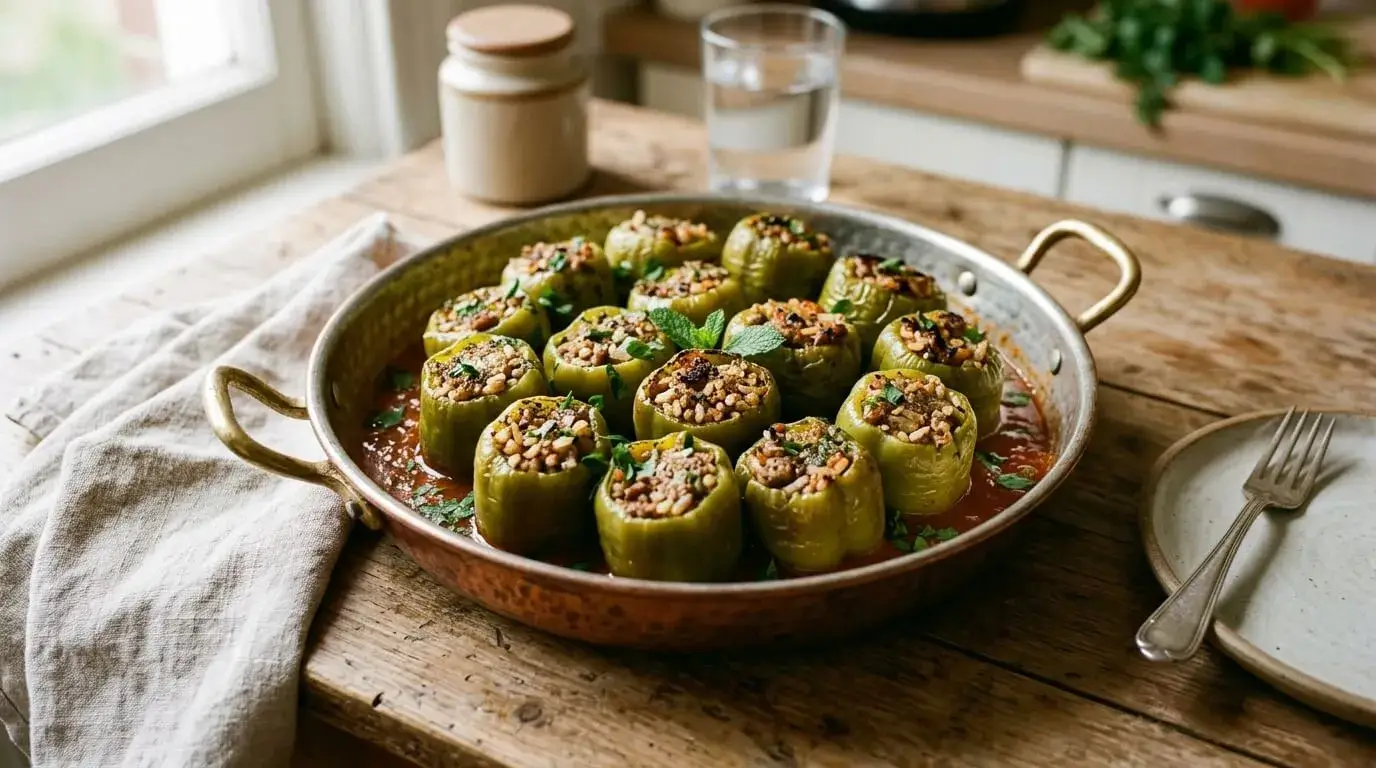
“Biber dolması” means “stuffed peppers” in Turkish and this version is filled with seasoned rice, ground meat, herbs and aromatics, then gently simmered until tender. Because Turkish stuffed peppers also have a major meatless tradition, zeytinyağlı biber dolması, cooked in olive oil and served cool. Moreover, this meat-filled recipe takes about 1 hour and 35 minutes from start to finish – here’s the terminology, the pepper guidance and the technique that gets it right.
Quick Answer
Turkish stuffed peppers or biber dolması, are peppers filled with seasoned rice, aromatics, and in this version, ground meat, then cooked upright in a covered pot with a tomato-based cooking liquid. Therefore, Turkish cuisine also includes a meatless zeytinyağlı biber dolması, typically served cool or at room temperature. Overall, for the meat-filled version below, plan on about 1 hour and 35 minutes from prep through resting, depending on your peppers’ size.
What Is Biber Dolması?
What “biber dolması” means
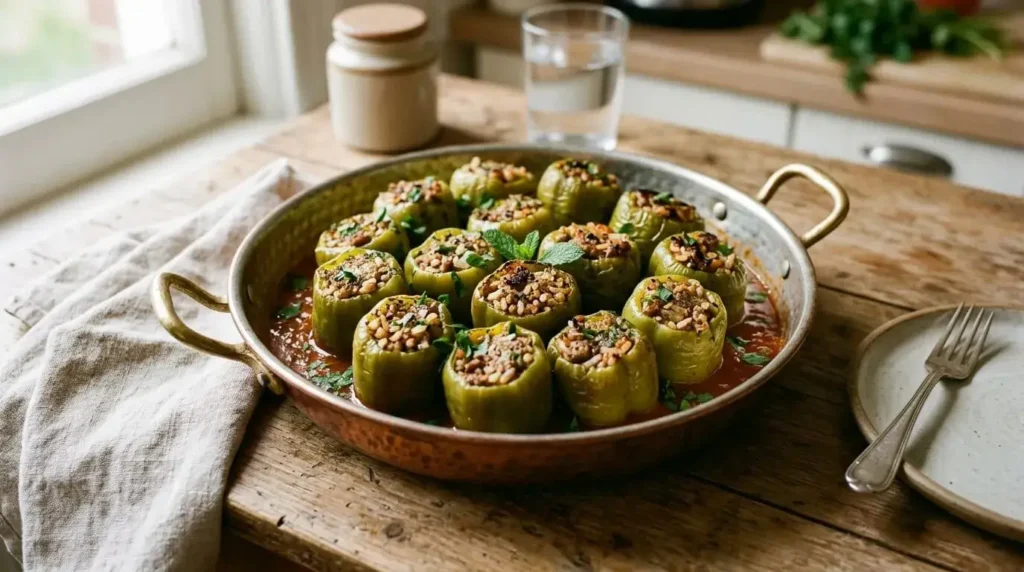
“Biber” means pepper and “dolma” refers to any stuffed vegetable, so “biber dolması” simply means stuffed pepper. Furthermore, from there, Turkish cooks distinguish between styles: etli (meat-filled), kıymalı (filled with ground meat specifically) and zeytinyağlı (olive-oil style, meatless). That’s why you’ll also see “sarma,” which refers to wrapped dishes like stuffed grape leaves – related to dolma, but not another word for stuffed peppers.
Is there one authentic Turkish stuffed pepper?
No. Turkish stuffed peppers vary by household and region and there isn’t a single fixed formula that every family follows. Therefore, this recipe is a meat-filled etli biber dolması made with rice, ground meat, onion and herbs – one traditional Turkish approach, not the only one. Moreover, later in this article, I’ll walk through the meatless zeytinyağlı version too, since it’s an equally legitimate part of the same culinary tradition, just built for a different occasion.
Meat-Filled vs. Zeytinyağlı Biber Dolması
Choose the meat-filled version if…
You want a warm, savory main dish. Moreover, this is the version built around ground beef or lamb, rice and aromatics, usually served with a spoonful of garlic yogurt on the side. Also, it’s substantial enough to be dinner on its own.
Choose the zeytinyağlı version if…
You want something meatless and olive-oil-forward. Therefore, the filling leans on rice, herbs and sometimes vegetables instead of meat and it’s traditionally served cool or at room temperature – which makes it a strong make-ahead option for a Turkish-style spread of cold dishes.
| Etli/Kıymalı | Zeytinyağlı | |
| Filling | Rice, ground meat and aromatics. | Rice and vegetables/herbs. |
| Main character | Savory and substantial. | Olive-oil and herb-forward. |
| Serving | Warm/room temperature. | Cool/room temperature. |
| Best for | Main meal. | Make-ahead/cold table. |
| Good accompaniment | Garlic yogurt. | Lemon and herbs. |
This table isn’t meant to represent every household’s version – just the two broad traditions this recipe sits between.
Which Peppers Are Best for Turkish Stuffed Peppers?
The Turkish pepper to look for
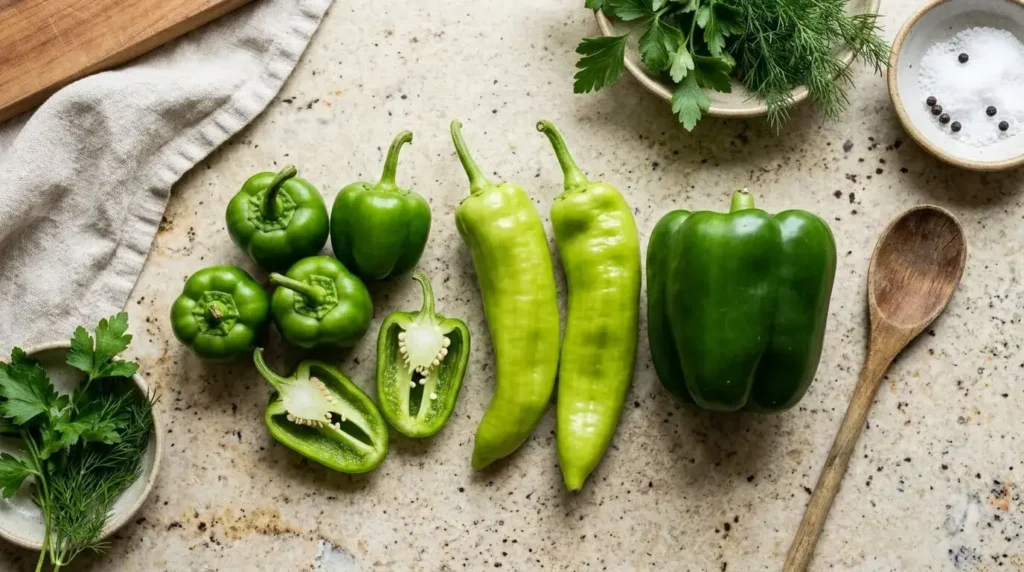
Traditional Turkish stuffing peppers or dolmalık biber, are generally small to medium and relatively thin-walled. However, that thinner wall matters – it cooks through evenly in the same time the rice needs to finish, without the pepper turning mushy or staying raw in the middle.
Best US supermarket substitutes
Most American grocery stores won’t carry true dolmalık biber, so here’s what actually works:
| Pepper | Recommendation | Why |
| Small green bell peppers | Best easy choice | Practical supermarket substitute. |
| Cubanelle peppers | Very good | Thin walls and good stuffing shape. |
| Mini bell peppers | Good | Smaller cavity; use less filling. |
| Large bell peppers | Works | May need longer cooking. |
| Narrow frying peppers | Usually avoid | Difficult to fill and keep upright. |
Why pepper size changes cooking time
Wall thickness, cavity size, how much filling goes in and how well heat can penetrate the pepper all affect how long it takes to cook. Also, a large, thick-walled supermarket bell pepper simply won’t behave like a small dolmalık biber and that’s fine – you just need to plan for more time and check for doneness rather than following a fixed clock.
Ingredients for Turkish Stuffed Peppers
The filling
The base filling is rice, ground beef or lamb, finely chopped onion, tomato, tomato paste, parsley, mint, black pepper and a pinch of red pepper flakes, all bound together with a little olive oil. because rice and meat both need enough moisture in the mixture to keep cooking once they’re inside the pepper – a filling that’s too dry going in will still be undercooked when the pepper is tender, which is one of the more common mistakes with this dish.
Turkish pepper paste and US substitutions
Turkish pepper paste (biber salçası) is the preferred ingredient for real depth of flavor. That’s why if you can’t find it, work down this substitution ladder: mild red pepper paste from a Middle Eastern grocery, then tomato paste blended with a little paprika or plain tomato paste on its own if nothing else is available. Further, these are practical American-kitchen adaptations, not identical stand-ins for the traditional ingredient – the flavor will be a little different, but the dish still works.
How to Make Turkish Stuffed Peppers
1. Prepare the peppers.
Cut the tops off cleanly and set them aside if you’re using them as lids. Overall, scoop out the seeds and any loose white ribs, being careful not to tear or thin the pepper walls, since that’s what will hold the filling and stay intact through cooking.
2. Prepare the rice and meat filling.
Combine partially cooked rice with the ground meat, onion, tomato, herbs, seasoning and pepper paste. Therefore, starting the rice partway through cooking rather than fully raw gives you a much more predictable result inside the pepper.
3. Cool the filling briefly.
If you’ve warmed anything while building the filling – sautéed onions, for instance – let it cool for a few minutes before mixing in the rice and meat. Then a hot filling is harder to handle and can make the peppers difficult to stuff evenly.
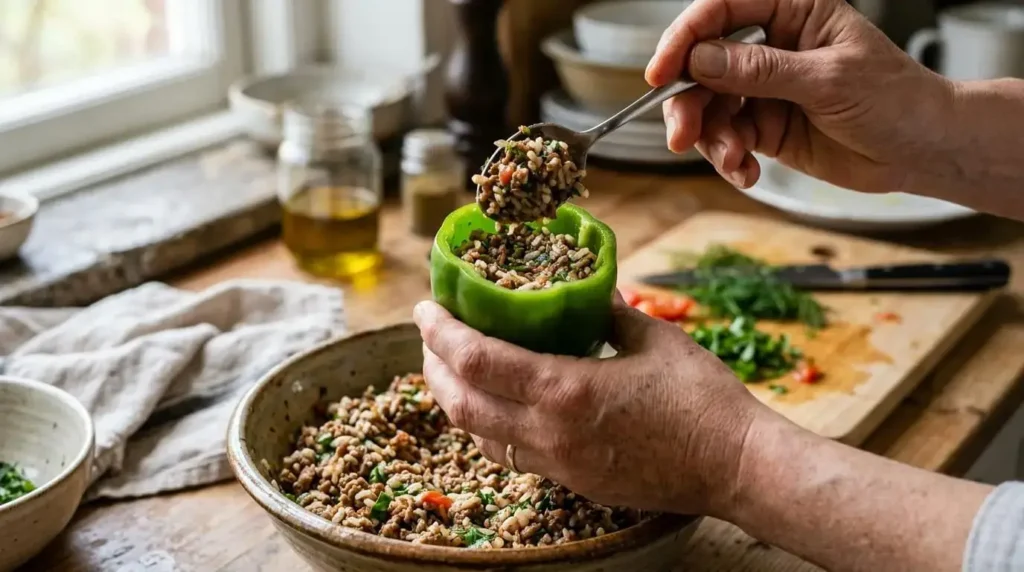
4. Fill the peppers loosely.
This is the step most home cooks get wrong. Further, leave about 1-2 cm of headspace at the top rather than packing the filling down tight. Moreover, rice expands significantly as it finishes cooking and an overpacked pepper is the most common cause of splitting.
5. Arrange the peppers upright.
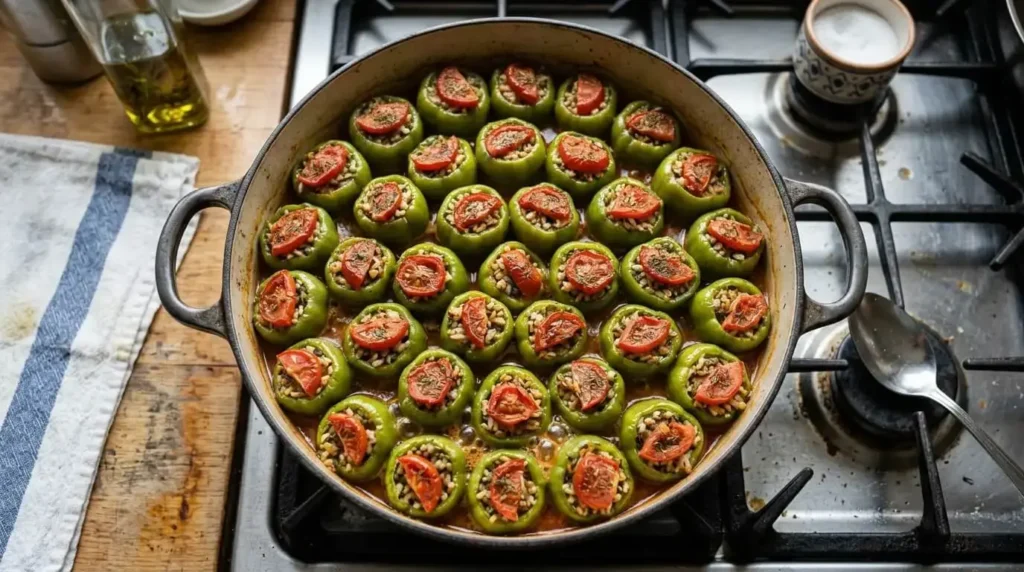
Before adding liquid, test the empty peppers in your pot to see how they fit. That’s why pack them in snugly, standing upright and leaning on one another for support – this keeps them from tipping over and losing filling as they cook.
6. Add the cooking liquid and simmer
Also add cooking liquid until it reaches roughly one-third to one-half of the pepper height, depending on your pot and the exact recipe. Therefore, cover and simmer gently rather than boiling hard, which can tear the peppers apart before the filling is done.
7. Check doneness and rest.
Don’t rely solely on the clock. Then check that the rice is tender, the pepper can be pierced easily but still holds its shape and the cooking liquid has reduced into a light sauce. Let the peppers rest for about 10 minutes off the heat before serving – they firm up and hold together much better after resting.
Why Cook the Rice Before Stuffing?
Partially cooked rice – recommended
I partially cook the rice before it goes into the peppers and it’s made the biggest difference in consistent results in my kitchen testing. Because it gives you far more predictable timing, an easier read on when the peppers are actually done and a much lower risk of ending up with crunchy rice in the center of an otherwise-cooked pepper.
Raw rice – possible, but slower
Using raw rice is possible, but it requires more liquid, more expansion room in the pepper and more total cooking time. However, it also varies more depending on your pepper size and pot – a large bell pepper with raw rice can take considerably longer than the same pepper with partially cooked rice, so budget extra time if you go this route.
How Long Do Turkish Stuffed Peppers Take?
I want to be upfront about this, because a lot of recipes online only quote the simmering time and leave out everything else. But here’s the real breakdown for this method:
| Stage | Time |
| Active prep | 40 minutes |
| Cooking | 45 minutes |
| Resting | 10 minutes |
| Total | 1 hour 35 minutes |
Many recipes quote only the simmering time after assembly. That’s why this recipe’s total time includes filling preparation, stuffing, bringing the pot to a simmer and resting – which is a more honest picture of what actually happens between deciding to make dinner and sitting down to eat it. Moreover, small- to medium-sized, thin-skinned peppers fit this timing well; large US bell peppers or a raw-rice filling can push the process closer to two hours. Then judge doneness by the checklist below rather than the clock alone.
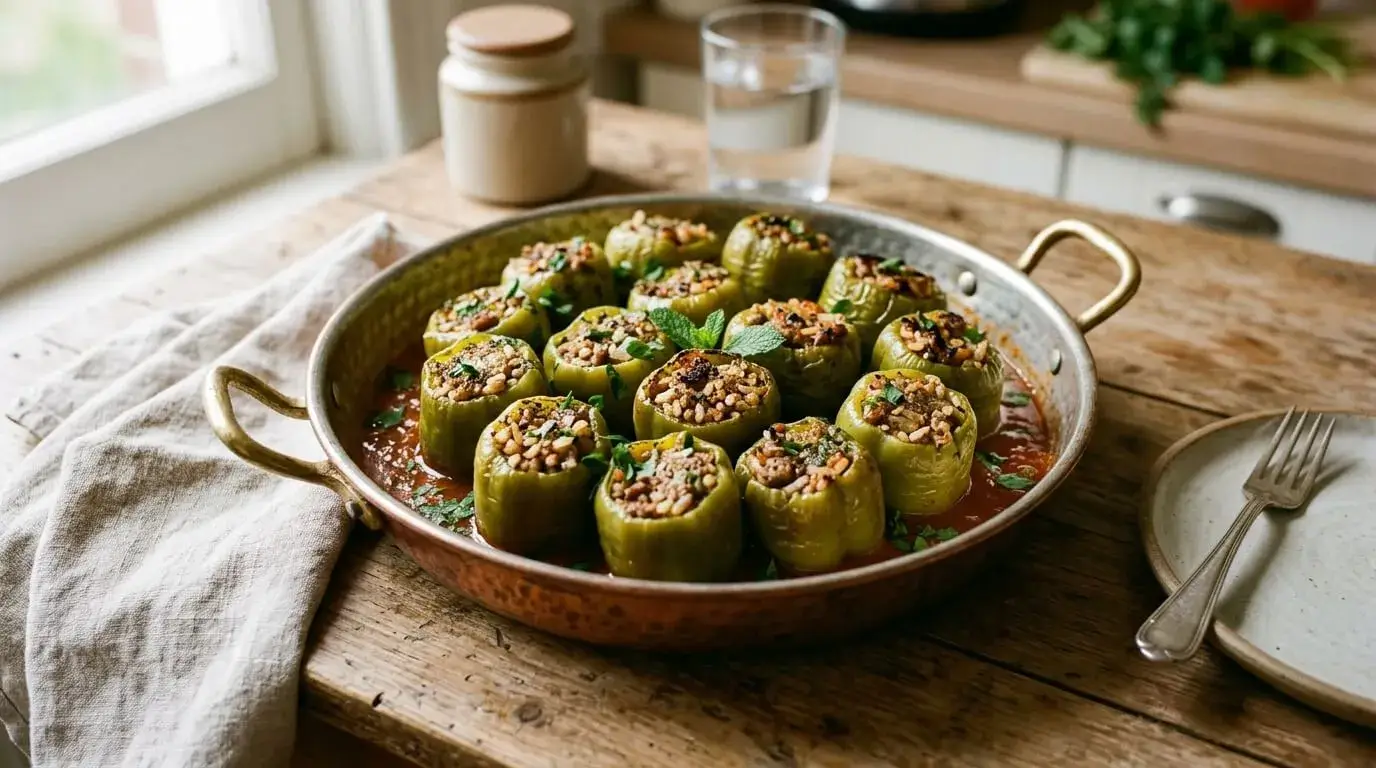
Stuffed Peppers (Biber Dolması) Turkish
Ingredients
Method
- ctions
Notes
- Pepper choice: Small, thin-walled peppers cook more predictably than large supermarket bell peppers.
- Don’t overfill: rice expands during cooking.
- Pepper paste: use Turkish pepper paste when available; otherwise use the stated US substitution.
- Timing: large peppers may need additional cooking time.
- Doneness: judge by tender peppers and fully cooked rice, not only the timer.
- Meat safety: for ground beef/lamb, verify the filling reaches 160°F / 71°C with a food thermometer (per USDA guidance).
Troubleshooting Turkish Stuffed Peppers
| Problem | Likely cause | Fix next time |
| Rice is crunchy. | Too little liquid / insufficient cooking. | Add adequate hot liquid; cook longer, covered. |
| Peppers split. | Overfilled. | Leave expansion space. |
| Filling is watery. | Excess liquid. | Reduce liquid and uncover briefly near the end. |
| Bottom burns. | Too little liquid/high heat. | Use a heavier pot and a gentler simmer. |
| Peppers collapse. | Overcooking/overcrowding. | Cook gently and fit peppers snugly. |
| Pepper is still tough. | Thick-walled/large pepper. | Extend cooking time. |
The doneness checklist
- Rice is tender
- Pepper is easily pierced but still holds its shape
- Cooking liquid has been reduced appropriately
- Ground meat has reached a safe internal temperature
- Peppers have rested before serving
For the meat filling, USDA guidance calls for ground beef and lamb to reach 160°F (71°C), checked with a food thermometer – worth doing even after the peppers look visually done, since color alone isn’t a reliable indicator with mixed fillings.
Turkish Stuffed Peppers: Regional and Culinary Variations
Zeytinyağlı olive-oil dolma
This is the meatless tradition built around rice, herbs and olive oil, typically served cool or at room temperature rather than as a hot main dish.
Etli and kıymalı versions
These are the meat-filled traditions – ground beef or lamb combined with rice and aromatics, served warm as a main course – which is the style this recipe follows.
Where bulgur fits
Bulgur genuinely appears in some Turkish dolma preparations, but it isn’t a universal or default grain for fresh green-pepper biber dolması and it shouldn’t be treated as a 1:1 swap for rice – bulgur absorbs liquid differently and needs its own adjusted cooking time.
Regional specialties are not universal rules.
Turkey has documented local dolma specialties – for instance, versions using dried peppers or preparations that lean more heavily on herbs than meat – but these reflect specific regional or household traditions rather than rules that apply nationwide and I’m not going to present a single province’s version as representative of the whole country.
Substitutions and Practical US Grocery Swaps
- Dolmalık biber → small green bell peppers.
- Turkish pepper paste → mild red pepper paste.
- No pepper paste available → tomato paste and paprika.
- Fresh mint → dried mint, using a smaller quantity.
- Ground lamb → ground beef.
- Rice → bulgur, only as a clearly labeled variation, not a direct swap.
One caution: don’t substitute brown rice, quinoa or couscous into this recipe expecting the same result. Moreover, their liquid absorption and cooking times are different enough that they’ll throw off both the filling texture and the total cooking time.
What to Serve With Turkish Stuffed Peppers
For the meat-filled version
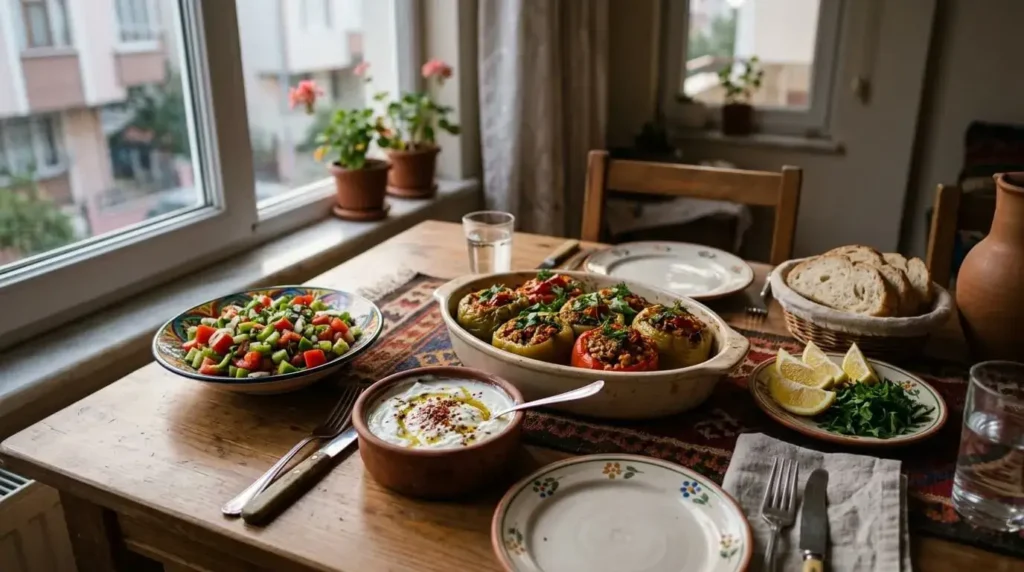
Garlic yogurt is the classic pairing, along with plain yogurt on the side, a simple shepherd’s salad, lemon wedges and fresh herbs.
For the olive-oil version
Lemon and fresh herbs are enough on their own and it fits naturally alongside other Turkish-style cold table or meze dishes.
Serving temperature really does come down to which style you’ve made – this isn’t a dish that’s always served one way or the other.
Storage and Reheating
Let leftovers cool before refrigerating and store them in a covered, airtight container. Because USDA guidance recommends refrigerating leftovers within two hours and using shallow containers so they cool faster and using cooked leftovers within 3-4 days. Overall, to reheat, warm the peppers gently and covered, with a little of the cooking liquid or sauce added back in – reheating uncovered at high heat tends to dry them out. Moreover, the olive-oil version, notably, is often at its best served cool straight from the refrigerator, which makes it a genuinely good make-ahead option.
Can you freeze them?
You can freeze the meat-filled version, though the texture of the rice and pepper will soften somewhat after thawing – it’s a reasonable option for make-ahead meals; just don’t expect the same texture as freshly made peppers.
Frequently Asked Questions
What does “biber dolması” mean?
“Biber dolması” means “stuffed pepper” in Turkish – biber is pepper and dolma is a stuffed vegetable. From there, cooks distinguish styles like etli (meat-filled) and zeytinyağlı (olive-oil, meatless), rather than one single fixed dish.
Are Turkish stuffed peppers served hot or cold?
It depends on the style. Therefore, meat-filled etli or kıymalı biber dolması is typically served warm as a main course. because the meatless zeytinyağlı version is traditionally served cool or at room temperature, often as part of a cold table.
Do you cook rice before stuffing peppers?
Partially cooking the rice first is the more predictable approach and what this recipe uses – it gives more even results and less risk of undercooked rice. Moreover, raw rice works too, but it needs more liquid, more expansion room and more total cooking time.
Can I make Turkish stuffed peppers vegetarian?
Yes – this is exactly what zeytinyağlı biber dolması is. Also, iteplaces the ground meat with a rice, herb and vegetable filling cooked in olive oil and is traditionally served cool rather than as a hot main dish.
Can I use bulgur instead of rice?
You can and bulgur does appear in some Turkish dolma traditions, but it’s not a direct 1:1 swap. Further, Bulgur absorbs liquid differently than rice, so treat it as its own variation with adjusted liquid and cooking time rather than a straight substitution.
What peppers are best for Turkish stuffed peppers?
Small, thin-walled peppers work best and cook most predictably – small green bell peppers or cubanelles are the easiest US supermarket substitutes for traditional dolmalık biber. Further, large bell peppers work too, but need extra cooking time due to their thicker walls.