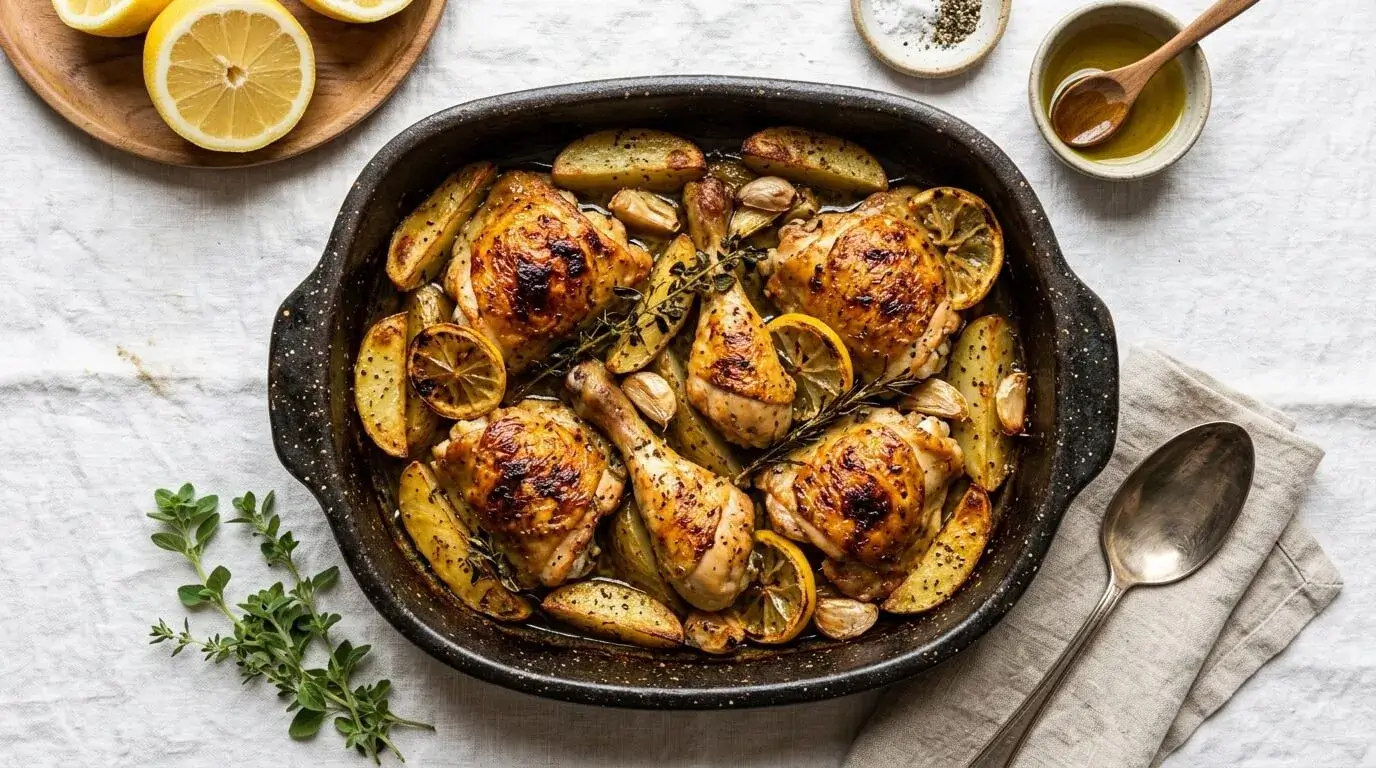
If there’s one dish that perfectly captures the soul of a Greek kitchen, it’s Greek lemon chicken – known in Greek as Kotopoulo Lemonato. The moment this dish slides into a hot oven, gleaming with olive oil and sharp with citrus, the entire house fills with an aroma that is immediately and unmistakably home. And for millions of Greek families, this isn’t simply dinner. It’s Sunday afternoon, it’s yiayia calling everyone to the table, it’s the dish that shows up at every celebration and quiet weeknight alike.
Kotopoulo Lemonato is a cornerstone of traditional Greek cooking for excellent reasons. It demands minimal ingredients, relies on ancient Mediterranean pantry staples and produces results that are nothing short of extraordinary – crispy-skinned chicken bathed in a glossy lemon-olive oil pan sauce, alongside potatoes that have absorbed every drop of flavor from the roasting dish. Additionally, it aligns naturally with the principles of the Mediterranean diet, making it as nourishing as it is delicious.
You’ll discover the true story behind this beloved classic in this guide, how to source and use authentic ingredients, common mistakes that compromise the dish and exactly how to cook it the way Greek home cooks have done for generations.
What Is Greek Lemon Chicken (Kotopoulo Lemonato)?
The name tells the whole story: kotopoulo means chicken in Greek and lemonato simply means “with lemon.” At its most essential, this is chicken slow-roasted with fresh lemon juice, extra virgin olive oil, whole garlic cloves and dried Greek oregano. Moreover, it’s always cooked alongside potatoes in the same baking dish, so everything melds into a deeply savory and citrus-forward pan sauce.
What separates authentic Kotopoulo Lemonato from generic lemon chicken recipes you’ll find online is both technique and proportion. Greek cooks don’t treat lemon as a subtle accent; they use it generously, allowing the citrus to break down the chicken, tenderize the meat and form a rich emulsified sauce with the olive oil as the dish roasts low and slow. The potatoes are not a side dish as an afterthought; they’re integral to the architecture of the recipe, absorbing the pan juices and becoming impossibly flavorful in their own right.
The flavor profile is bold yet beautifully balanced: bracingly tart lemon, earthy and aromatic oregano, mellowed garlic that sweetens as it roasts and the deep fruity character of quality extra virgin olive oil. Additionally, the chicken skin crisps and caramelizes to a deep amber, the meat stays remarkably juicy and the potatoes develop a golden and slightly crispy exterior concealing a creamy, herb-infused center.
The History and Cultural Significance of Kotopoulo Lemonato
Greek culinary tradition is built on three pillars: simplicity, seasonality and community. Kotopoulo Lemonato embodies all three. While tracing an exact historical origin is difficult – this style of lemon-braised and lemon-roasted chicken appears across Greece’s many regional cuisines – the dish has been a household staple for centuries, shaped by the landscape, the climate and the rhythms of Greek family life.
Regional variations tell their own stories. In northern Greece, cooks often add a splash of dry white wine to the roasting pan. On the Aegean islands, local dried thyme joins the oregano. In Athens and central Greece, the recipe tends to stay close to its purest form: chicken, lemon, olive oil, garlic, and oregano — nothing more, nothing subtracted.
What remains consistent across every region is the role this dish plays in Greek domestic life. Sunday dinner in Greece is a sacred institution, a midday meal that draws extended families together for hours of eating, conversation, and genuine connection. Kotopoulo Lemonato earns its place on those tables because it is both deeply practical and genuinely impressive: you prepare it, slide it into the oven, and the dish finishes itself while you tend to guests and pour the wine.
The role of olive oil and citrus in Greek cooking cannot be overstated. Greece is among the world’s largest producers of extra virgin olive oil, and the relationship between Greek cooks and their oil is intimate and personal – many families still source directly from their own trees or from trusted regional producers. Lemons, thriving throughout the Mediterranean climate, are used with the same generosity and complete absence of restraint. Together, they form the backbone of classic Greek cuisine.
Why Greek Lemon Chicken Is a Mediterranean Diet Favorite
The Mediterranean diet is consistently ranked among the world’s healthiest and most sustainable eating patterns and Kotopoulo Lemonato fits its principles with almost embarrassing perfection. Every ingredient on the list is a whole food: quality chicken, fresh lemons, extra virgin olive oil, garlic, dried herbs and vegetables. There are no processed components, no artificial flavors and no shortcuts.
The olive oil delivers heart-healthy monounsaturated fats and a remarkable concentration of polyphenols and antioxidants. The chicken provides lean, complete protein essential for muscle maintenance and lasting satiety. Garlic consistently contributes organosulfur compounds associated with cardiovascular and immune health. Fresh lemon juice adds vitamin C and natural brightness without contributing meaningful calories. Even the potatoes – often unfairly avoided in modern diet culture — offer potassium, dietary fiber, and complex carbohydrates when roasted in olive oil rather than deep-fried in refined fats.
This is precisely the style of eating that Mediterranean communities have practiced for generations: balanced, ingredient-forward, cooked from scratch, and shared at a table. For a broader exploration of the culinary heritage this dish belongs to, Mediterranean Cuisines is an excellent guide to the richness and diversity of the region’s food traditions.
Authentic Ingredients for Greek Lemon Chicken
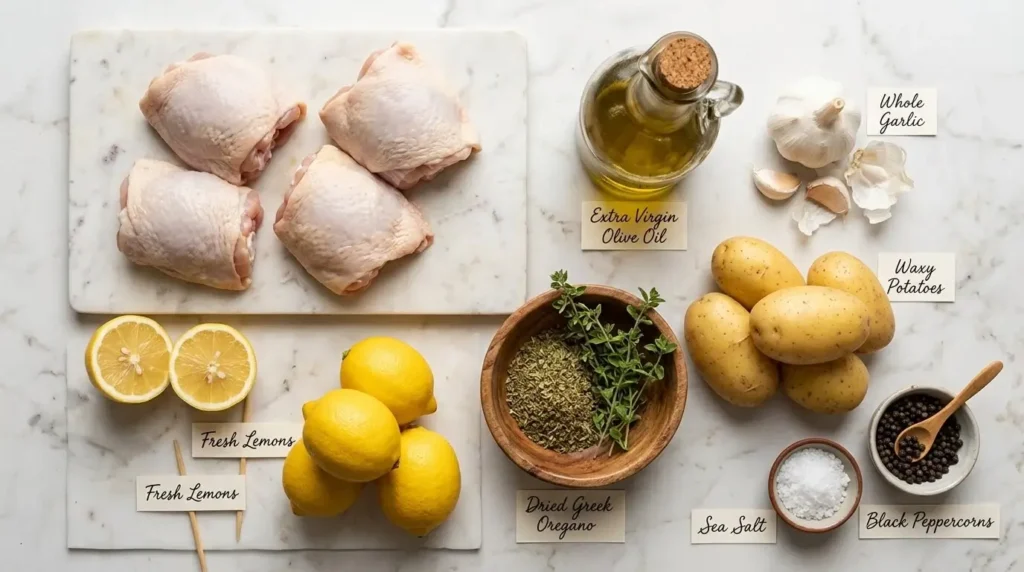
Chicken
Bone-in, skin-on pieces are non-negotiable here. Chicken thighs and drumsticks are the most traditional choice — their fat renders beautifully into the pan sauce during roasting, and the meat remains forgiving and moist even at high heat. A whole chicken cut into pieces is equally traditional and produces excellent results. Avoid boneless, skinless cuts entirely: you sacrifice the rendered fat, the collagen-rich drippings, the caramelized skin, and ultimately the flavors that define the dish.
Fresh Lemons
Use only fresh lemons — never bottled lemon juice. Greek cooking demands the aromatic oils in fresh lemon zest and the clean, bright acidity of freshly squeezed juice that bottled products simply cannot replicate. Plan on one large, unwaxed lemon per 500g (1 lb) of chicken, both for juice and zest.
Extra Virgin Olive Oil
Quality matters more here than in almost any other recipe. A robust, peppery Greek extra virgin olive oil — from Kalamata or Cretan cultivars — delivers a fruity depth and a slight bitterness that mild supermarket olive oil cannot approximate. Because the oil forms the base of your pan sauce, use the best you have access to.
Garlic
Use whole peeled cloves or cloves roughly crushed with the flat of a knife — not minced, not pressed. Greek cooks add garlic in large, rustic pieces that roast slowly in the pan, mellowing and sweetening over the cooking time and releasing their flavor gradually into the surrounding juices.
Greek Oregano
This is the point where many international recipes quietly go wrong. Greek dried oregano (rigani) is a specific wild variety — more intensely aromatic, more pungent, and slightly more bitter than Italian dried oregano or the standard jars found in most supermarkets. The difference in flavor is immediately apparent. Seek it out at Greek, Mediterranean, or Middle Eastern grocery stores. It is worth the effort.
Potatoes
Waxy or all-purpose potatoes cut into large, generous wedges are ideal. They hold their shape throughout the long roasting time, develop a caramelized exterior, and absorb the lemon-olive oil pan juices without disintegrating. Yukon Golds are an excellent widely available choice. Avoid starchy varieties like russets, which tend to become too soft.
Salt and Pepper
Season with genuine confidence. Greek cooking does not apologize for salt. With the volume of lemon and olive oil in this dish, it can absorb generous seasoning without the finished result ever tasting overtly salty.
Traditional Greek Lemon Chicken Recipe
Recipe Details
| Prep Time | 20 minutes |
| Marinating Time | 30 minutes (optional but recommended) |
| Cook Time | 1 hour 15 minutes |
| Total Time | 1 hour 35 minutes |
| Servings | 4–6 |
| Cuisine | Greek / Mediterranean |
| Course | Main Course |
| Skill Level | Easy–Intermediate |
Ingredients
Chicken and Potatoes:
- 1.5 kg (3.3 lbs) bone-in, skin-on chicken pieces (thighs, drumsticks, or a whole chicken cut into pieces)
- 1 kg (2.2 lbs) waxy potatoes, peeled and cut into large wedges
- 120 ml (½ cup) extra virgin olive oil
- 120 ml (½ cup) fresh lemon juice (approximately 3–4 large lemons)
- Zest of 1 large lemon
- 6 garlic cloves, peeled and lightly crushed
- 2 tablespoons dried Greek oregano (rigani)
- 1½ teaspoons fine sea salt, plus more to taste
- ½ teaspoon freshly ground black pepper
- 240 ml (1 cup) warm water or low-sodium chicken broth
Instructions
Step 1 — Marinate the Chicken Whisk together the lemon juice, lemon zest, olive oil, oregano, salt, and pepper in a large mixing bowl until combined. Add the chicken pieces and toss thoroughly to coat every surface. Cover the bowl with plastic wrap and refrigerate for a minimum of 30 minutes, or up to 4 hours for deeper, more penetrating flavor. Remove from the refrigerator 15 minutes before roasting to bring to room temperature.
Step 2 — Preheat the Oven Preheat your oven to 200°C (400°F / Gas Mark 6). Position the rack in the center of the oven.
Step 3 — Prepare the Baking Dish Arrange the potato wedges in a single layer across a large, deep baking dish (approximately 33×23 cm / 13×9 inch). Season the potatoes lightly with salt and a twist of black pepper. Nestle the marinated chicken pieces over and among the potatoes, skin side facing up. Pour all remaining marinade from the bowl directly over the chicken and potatoes, then scatter in the crushed garlic cloves. Add the warm water or chicken broth to the bottom of the pan — this is what will become your pan sauce.
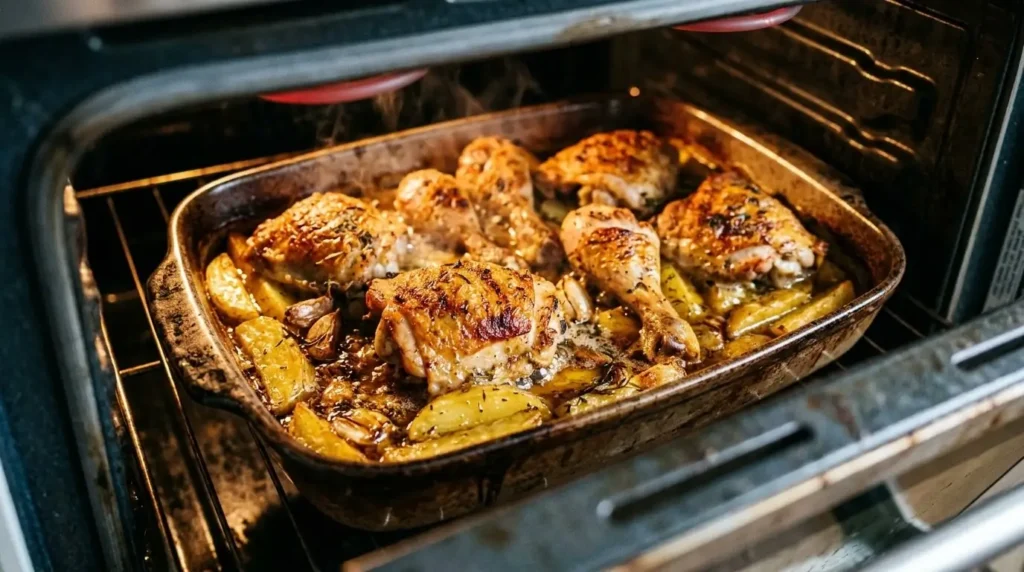
Step 4 — First Roast Place the uncovered baking dish in the preheated oven. Roast for 45 minutes. The chicken skin should be turning golden and the pan juices should be active and aromatic.
Step 5 — Baste and Finish Carefully remove the dish from the oven. Using a large spoon or pastry brush, baste the chicken pieces and potato wedges generously with the pan juices. Return immediately to the oven and continue roasting for a further 25–30 minutes, until the chicken skin is deeply golden and crisped at the edges, the potatoes are fork-tender with caramelized, golden exteriors, and the internal temperature of the thickest part of the chicken reads 74°C (165°F) on an instant-read thermometer.
Step 6 — Rest and Develop the Sauce Remove the dish from the oven and allow it to rest, uncovered, for 10 minutes. During this resting period, the pan juices settle and concentrate into a glossy, intensely flavored lemon-olive oil sauce. Spoon it generously over the chicken and potatoes when you serve.
Step 7 — Serve Transfer to a large warmed serving platter, or bring the baking dish directly to the table — which is entirely the Greek way. Finish with a final squeeze of fresh lemon juice and an extra scatter of dried oregano if desired.
Chef’s Expert Tips
Always use room-temperature chicken. Cold chicken straight from the refrigerator extends roasting time unpredictably and produces tougher, drier meat. Pull it out 15–20 minutes before it goes in the oven.
Do not crowd the pan. The chicken pieces and potatoes need space around them for heat to circulate properly. Crowding causes the oven to steam rather than roast, which means no caramelization and no crispy skin. Use two pans if your chicken is large.
Add the liquid purposefully. The water or broth at the bottom of the pan prevents burning and provides the base for your sauce. Don’t skip it — but don’t increase it either. You want a concentrated, glossy sauce, not a watery pool.
Finish with fresh lemon at the table. A final squeeze of fresh lemon juice right before serving restores the bright citrus notes that mellow during roasting and lifts the entire dish.
Always rest the chicken. Ten minutes of resting before serving allows the juices to redistribute through the meat. Every bite will be noticeably more tender and juicy as a result.
Common Mistakes to Avoid
- Using bottled lemon juice. Bottled lemon juice is processed, flat, and stripped of the aromatic zest oils that give this dish its distinctive character. Fresh lemons are not interchangeable with the bottle.
- Choosing the wrong chicken cuts. Boneless, skinless chicken breasts dry out long before the potatoes finish cooking and produce almost no drippings. Bone-in, skin-on pieces are essential to the recipe’s success.
- Under-seasoning the dish. With this volume of lemon and olive oil, the recipe can absorb generous salt. Timid seasoning produces a flat, disappointing result that tastes of missed potential.
- Reducing the olive oil. Some cooks attempt to “lighten” the recipe by cutting the olive oil. This is a mistake — the oil is what forms the emulsified pan sauce that defines the dish. Reduce it and the sauce becomes thin, separated, and flavorless.
- Opening the oven door repeatedly. Every time the oven door opens, the temperature drops significantly and the caramelization process on the chicken skin resets. Baste once mid-cook and resist the urge to check constantly.
- Cutting potatoes too small. Small potato pieces overcook and disintegrate into the pan. Large wedges are intentional — they hold their structure, caramelize on the outside, and stay creamy and flavorful inside.
What to Serve with Greek Lemon Chicken
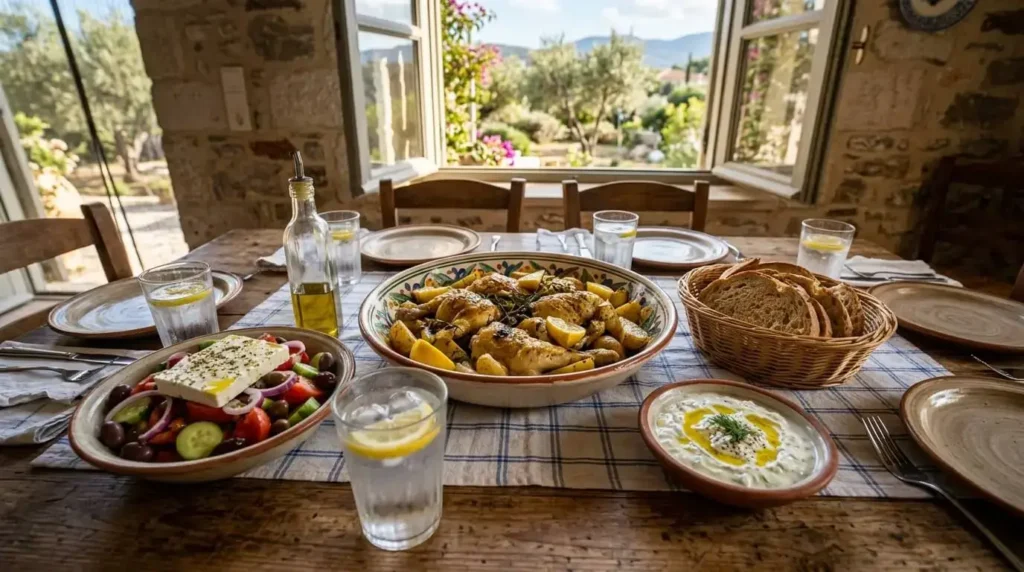
An authentic Greek family dinner built around Kotopoulo Lemonato would typically include:
Greek Village Salad (Horiatiki): Fresh tomatoes, cucumber, Kalamata olives, and thick-cut feta drizzled with olive oil. The sharp brightness cuts perfectly through the richness of the roasted chicken.
Tzatziki: Cool, creamy, garlicky yogurt dip that functions as both a dipping sauce and a refreshing counterbalance. Particularly lovely alongside the potatoes.
Crusty Bread: Entirely non-optional. A good sourdough or rustic country loaf is essential for mopping up the lemon-olive oil pan sauce — arguably the best part of the whole meal.
Rice or Orzo Pilaf: For particularly large or hungry tables, a simple pilaf alongside the roasted potatoes is perfectly authentic and makes the meal more substantial.
Seasonal Vegetables: Roasted zucchini, green beans slow-cooked in tomato sauce (fasolakia), or simple steamed leafy greens dressed with olive oil and lemon echo the dish’s Mediterranean character beautifully.
Storage and Reheating Instructions
Refrigeration: Allow the chicken and potatoes to cool completely before transferring to airtight containers. Store in the refrigerator for up to 3–4 days. Always store the pan juices separately — they’re even better the next day when the flavors have had time to deepen.
Freezing: Freeze in airtight freezer-safe containers for up to 2 months. The chicken freezes very well. Note that potato texture softens noticeably after freezing and thawing; if this concerns you, freeze the chicken separately and make fresh potatoes when reheating.
Reheating: Place in a covered baking dish with a splash of water or chicken broth to prevent drying. Reheat at 175°C (350°F) for 20–25 minutes, until heated through. Avoid microwaving the chicken — it toughens the meat and destroys the crispy skin.
Nutritional Information
Estimated values per serving, based on 6 servings. Nutritional content will vary depending on the specific size of chicken pieces, type of potato, and exact quantities of olive oil used. These figures are provided as general guidance only.
| Nutrient | Per Serving (approx.) |
| Calories | ~520 kcal |
| Protein | 38 g |
| Total Fat | 28 g |
| Saturated Fat | 6 g |
| Carbohydrates | 32 g |
| Dietary Fiber | 4 g |
| Sugar | 3 g |
| Sodium | 620 mg |
Frequently Asked Questions
What is Kotopoulo Lemonato?
Kotopoulo Lemonato is a traditional Greek roasted chicken dish prepared with fresh lemon juice, extra virgin olive oil, garlic, and dried Greek oregano, always roasted alongside potato wedges in a single baking dish. The name translates directly from Greek as “lemon chicken,” and it is one of the most beloved staples of everyday Greek cooking.
Can I use only chicken thighs for this recipe?
Yes — bone-in, skin-on chicken thighs are arguably the single best cut for Kotopoulo Lemonato. They are more forgiving than breasts, stay moist and flavorful throughout long roasting times, and produce excellent rendered fat that enriches the pan sauce. Many Greek home cooks use thighs and drumsticks exclusively.
Why do the potatoes in Greek lemon chicken taste so exceptional?
The potatoes cook in the same roasting dish as the chicken, absorbing the rendered chicken fat, fresh lemon juice, olive oil, and concentrated pan drippings over the full cooking time. This depth of flavor is impossible to replicate when roasting potatoes separately. The lemon-olive oil sauce essentially braises the cut surfaces of the potato while the exposed edges caramelize in the oven heat.
Can I make this recipe ahead of time?
Yes, and it actually improves with time. You can marinate the chicken overnight for deeper seasoning and flavor penetration. You can also roast the dish fully, allow it to cool, refrigerate it, and reheat it the following day — the flavors continue to develop overnight, and many people find day-old Kotopoulo Lemonato even more satisfying than freshly made.
Can Greek lemon chicken be frozen?
Yes, for up to 2 months in airtight, freezer-safe containers. The chicken freezes extremely well and reheats beautifully. The potatoes will soften in texture after freezing and thawing but remain flavorful. For best results, freeze the chicken and sauce separately from the potatoes and prepare fresh potatoes when reheating.
How long does leftover Greek lemon chicken last in the refrigerator?
Stored in an airtight container, it will keep for 3-4 days in the refrigerator. Store the pan juices alongside the chicken and potatoes — they function as a natural basting liquid when reheating and continue to concentrate and improve in flavor.
What specifically makes this recipe authentic?
Authenticity in Kotopoulo Lemonato comes from a combination of factors: using bone-in, skin-on chicken cuts, fresh lemons rather than bottled juice, genuine Greek dried oregano (rigani) rather than standard dried oregano, quality Greek extra virgin olive oil, and roasting the chicken and potatoes together in the same pan from start to finish. The proportions of lemon and olive oil, used generously rather than sparingly, are equally important to the authentic result.
Is Greek lemon chicken a suitable Mediterranean diet recipe?
Entirely. Kotopoulo Lemonato is a textbook example of Mediterranean diet cooking: whole-food ingredients, healthy fats from extra virgin olive oil, quality protein, vegetables, and simple preparation with no processed components. It is nutritionally balanced and reflects the traditional eating patterns that have supported the health and longevity of Mediterranean populations for centuries.
Conclusion
Greek lemon chicken — Kotopoulo Lemonato — is one of those rare dishes that manages to be simultaneously effortless to prepare and genuinely moving to eat. It carries centuries of Greek culinary tradition in every component: the assertive brightness of fresh lemon, the deep fruity richness of extra virgin olive oil, the sweet warmth of slow-roasted garlic, and the unmistakable herbal intensity of authentic Greek oregano. It is a dish that has nourished Greek families through generations of Sunday dinners, festive gatherings, and the quiet weeknight meals that become something more meaningful when they are shared around a table.
Beyond its deep cultural roots, this traditional Greek chicken recipe aligns naturally and beautifully with the Mediterranean diet — whole ingredients, considered preparation, genuinely nourishing, and profoundly satisfying. It is perhaps the clearest proof that healthy cooking and extraordinary flavor are not competing ambitions.
Whether you’re making Kotopoulo Lemonato for the very first time or returning to a recipe you’ve loved for years, it deserves a permanent place in your cooking repertoire. Make it once, serve it to people you care about, and you will understand immediately and completely why it has endured as a cornerstone of classic Greek cuisine.