This healthy eggplant Parmesan recipe swaps frying for roasting, so you get tender eggplant, concentrated tomato sauce and melted cheese without a pool of oil at the bottom of the dish. However, it’s a lighter-baked adaptation inspired by traditional Southern Italian Parmigiana di melanzane, not a claim that baking has always been the way it’s been made. because the goal here is a dish that still tastes like eggplant Parmesan, just built with more control over oil, moisture and cheese.
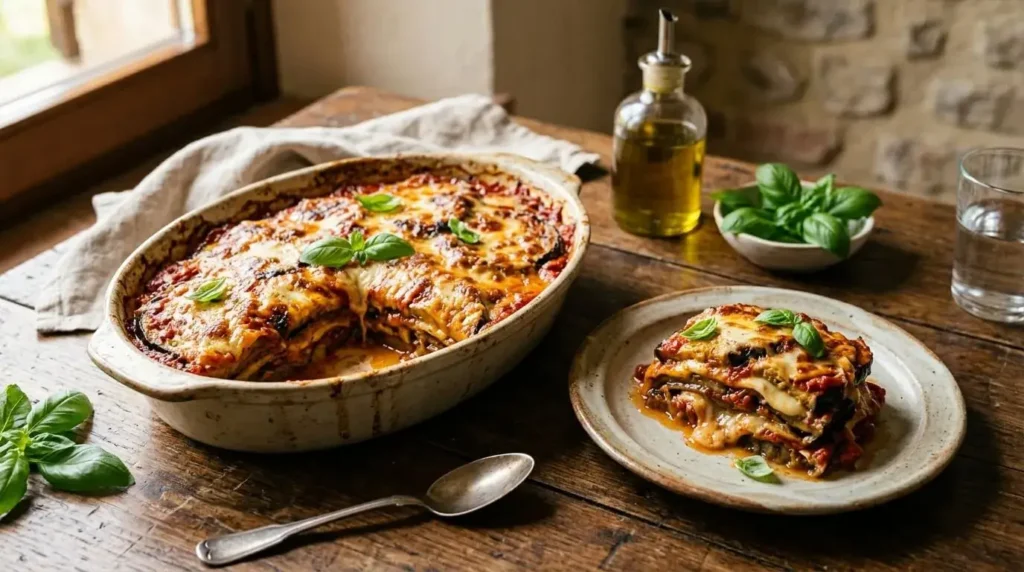
Quick Answer: Can Eggplant Parmesan Be Healthy?
Yes, eggplant Parmesan can fit into a balanced eating pattern, but whether a specific version is “healthy” depends on how it’s made. Therefore, for frying versus roasting, how much oil and cheese go in, sodium levels and portion size all matter more than the name of the dish. Because this baked version is built to be lighter by design, it isn’t automatically low-calorie or a diet food.
What Makes This Eggplant Parmesan Healthier?
Five changes separate this recipe from a standard fried version. But first, the eggplant is roasted instead of fried, which removes the need for the eggplant to absorb a shallow bath of oil as it cooks. Also, second, the olive oil is measured rather than added freely, so you control exactly how much goes into the dish. Because, third, the tomato sauce is simmered down until it’s thick and concentrated, which cuts down on excess liquid and lets the flavor carry more weight per spoonful. Further, the cheese is used strategically rather than eliminated – this isn’t a low-fat casserole that skips cheese entirely; it’s one that uses enough for real flavor without piling it on. Hence, fifth, the finished casserole rests before slicing, which helps it hold together instead of turning into a watery mess on the plate.
None of these changes are about making the dish taste less. That’s why they’re about controlling the variables that usually make “healthy” versions of casseroles either bland or soupy.
How to Make Eggplant Parmesan Healthier
- Roast the eggplant instead of frying it.
- Measure the olive oil rather than pouring freely.
- Use enough cheese for flavor, not an excessive amount.
- Reduce the tomato sauce until it’s thick.
- Rest the casserole before cutting into it.
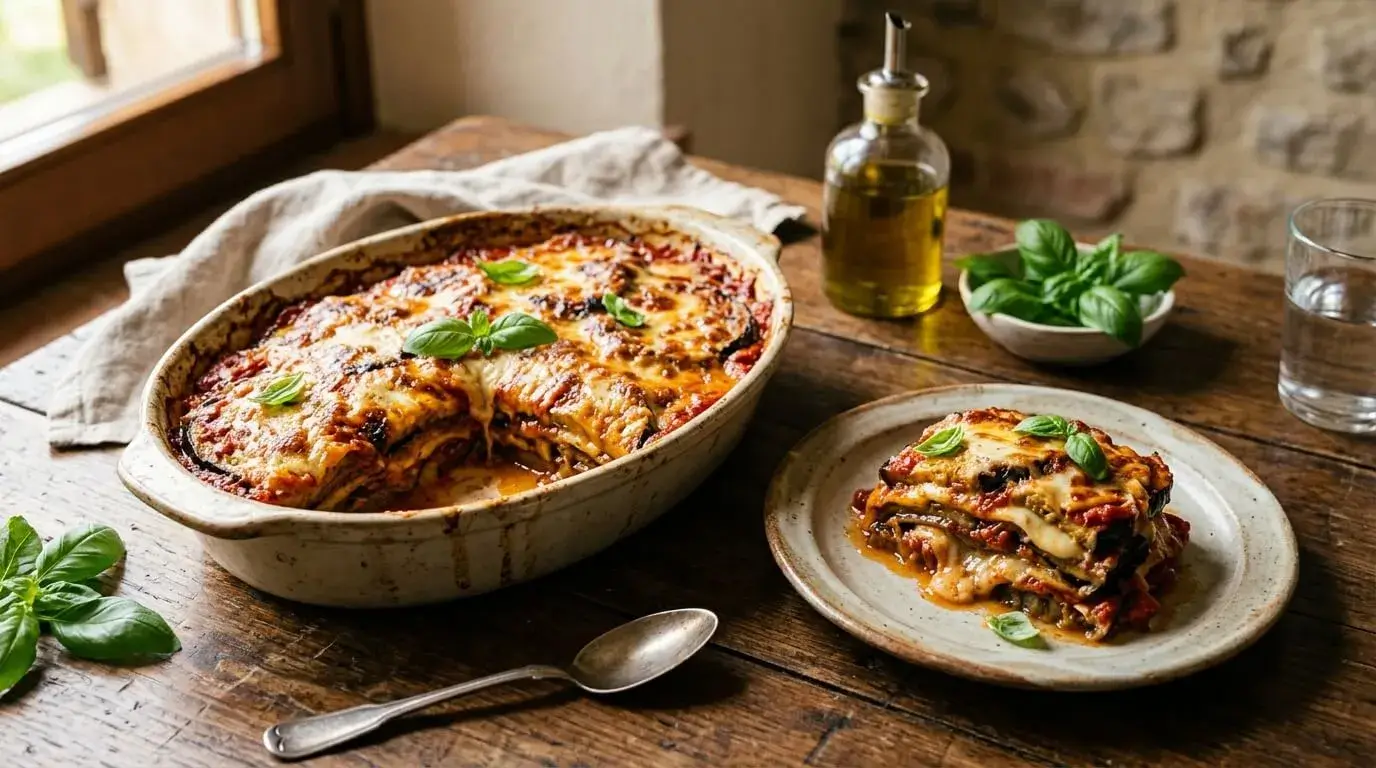
Healthy Eggplant Parmesan (Baked & Lighter)
Ingredients
Method
Notes
- Best eggplant: firm, unblemished, with a relatively even diameter.
- Moisture control: drain/dry mozzarella well and reduce the tomato sauce fully.
- Breadcrumb-free: the default version omits breadcrumbs entirely.
- Cheese substitution: low-moisture mozzarella gives a drier result than very wet fresh mozzarella.
- Make-ahead: the sauce and roasted eggplant can both be prepared in advance.
- Resting: let the casserole settle before slicing.
- Timing: total time includes passive salting and resting, not just active cooking.
Traditional Parmigiana di Melanzane: What Is Authentic?
Parmigiana di melanzane is the Italian name for eggplant Parmesan and its roots are in Southern Italy. Moreover, traditional recipes vary by region and household, but most reference preparations share a common backbone: salted eggplant, fried until golden, layered with a reduced tomato sauce, fresh basil, a melting cheese like fiordilatte or mozzarella and a grated hard cheese, then baked and rested before serving. However, The Accademia Italiana della Cucina documents a version built on exactly these elements – salted and fried eggplant, reduced tomato sauce, fiordilatte, Parmesan, basil, layered assembly, baking and resting.
That’s the culinary benchmark this recipe is adapted from. Also, it is not the recipe itself, since frying, not roasting, is the traditional method.
Is Eggplant Parmesan Sicilian or Neapolitan?
Both regions claim strong ties to the dish and there isn’t a single, universally agreed-upon “authentic” version. Since Sicily and Campania (home to Naples) each have their own take, differing mainly in how the eggplant is prepared and which cheeses take center stage. because “Parmigiana” doesn’t refer to Parma or Emilia-Romagna, despite the name’s resemblance to Parmigiano Reggiano – most food historians trace it instead to “Parmigiana,” a Sicilian dialect word for the overlapping wood slats of a shutter, which the layered eggplant slices resemble.
| Region | Eggplant treatment | Typical cheese emphasis | Key characteristic |
| Sicily | Fried, sometimes with a light coating. | Caciocavallo, pecorino. | Firmer layers, more pronounced cheese flavor. |
| Campania/Naples | Fried, often thinner slices. | Fiordilatte, Parmigiano Reggiano. | Softer, sauce-forward layers. |
Traditional vs. This Lighter Baked Version
This recipe is a lighter adaptation, not a claim that roasted eggplant is the traditional preparation. Here’s exactly what’s different:
| Dimension | Traditional reference | This lighter version |
| Eggplant | Salted/fried | Salted, dried and roasted. |
| Oil | Frying oil | Measured olive oil. |
| Breading | Regional variation | Breadcrumb-free default. |
| Cheese | Regional/generous | Strategically measured. |
| Sauce | Concentrated tomato sauce | Concentrated tomato sauce. |
| Cooking | Fry and bake | Roast and bake. |
| Result | Rich, traditional | Lighter, still layered and satisfying. |
The sauce, layering, basil and cheese-forward character stay the same. What changes is how the eggplant gets cooked and how much oil the dish carries.
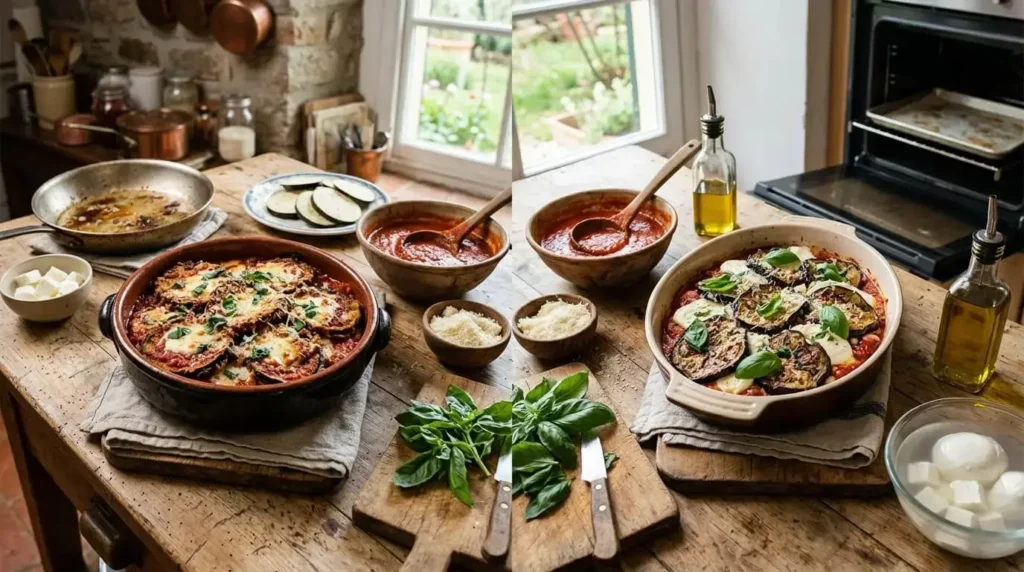
Ingredients & Smart Substitutions
Eggplant
Look for firm, unblemished eggplant with an even diameter so your slices roast at the same rate. because Italian or globe eggplant both work. Slicing evenly (about ½ inch thick) matters more than you’d think – uneven slices mean some pieces are tender while others are still firm. furthermoreSalting isn’t a magic bitterness fix so much as a moisture-management step: it draws out excess water so the slices roast instead of steam.
Cheese Choices
Fiordilatte and fresh mozzarella give you that classic pull and milky flavor, but they also carry the most moisture – drain them well. However, low-moisture mozzarella is a practical U.S. grocery-store swap that gives a drier, more predictable result. because Parmesan or Parmigiano Reggiano adds the salty, savory top note. But if you want to nod to the regional variations, pecorino or caciocavallo (harder to find, but worth seeking out at an Italian market) brings a sharper edge.
Breadcrumbs or No Breadcrumbs?
Choose breadcrumb-free if you want the simplest version, the lighter default or a gluten-free preparation – the recipe below is written this way. Further, choose a small panko-Parmesan topping if you want extra crunch and more browning on top. Then Breadcrumbs isn’t a universal authenticity requirement; some regional versions use them, others don’t.
| Traditional/ideal ingredient | US alternative | What changes |
| Fiordilatte | Low-moisture mozzarella | Drier, firmer result. |
| Caciocavallo | Provolone or extra pecorino | Milder but still sharp. |
| San Marzano tomatoes | Crushed or passata-style tomatoes | Similar sweetness, more convenient. |
| Fried eggplant | Roasted eggplant | Less oil absorption. |
How to Make Healthy Eggplant Parmesan
Slice, Salt, and Dry the Eggplant
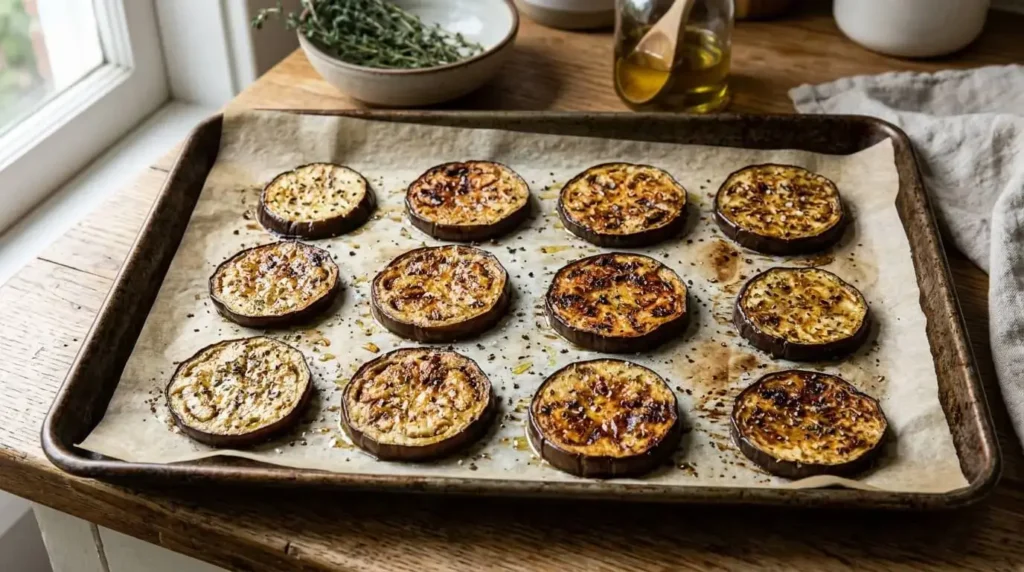
Slice the eggplant into even rounds, arrange them in a single layer, salt lightly and let them sit for 30-45 minutes. Furthermore, Pat, every slice is thoroughly dry before roasting – leftover surface moisture is one of the biggest reasons eggplant Parmesan turns watery.
Roast Until Fully Tender
Don’t pull the eggplant out early. Under-roasted slices still hold structure when they go into the oven raw-ish, but they turn tough and chewy once baked under sauce and cheese. Because the slices need to be fully tender and lightly browned before you start layering – this is not optional.
Reduce the Tomato Sauce
A thin sauce is the fastest way to end up with a soupy casserole. Simmer the sauce until it’s noticeably thickened – it shouldn’t run freely off a spoon. Moreover, This concentration step matters even more in a lighter version, since you’re not relying on absorbed frying oil to bind the layers.
Layer Without Over-Saucing
Build in thin, controlled layers: a little sauce on the bottom, then eggplant, mozzarella, Parmesan and torn basil, repeated. Further, resist the urge to flood each layer – a thin coat is enough when the sauce is properly reduced.
Bake, Brown, and Rest
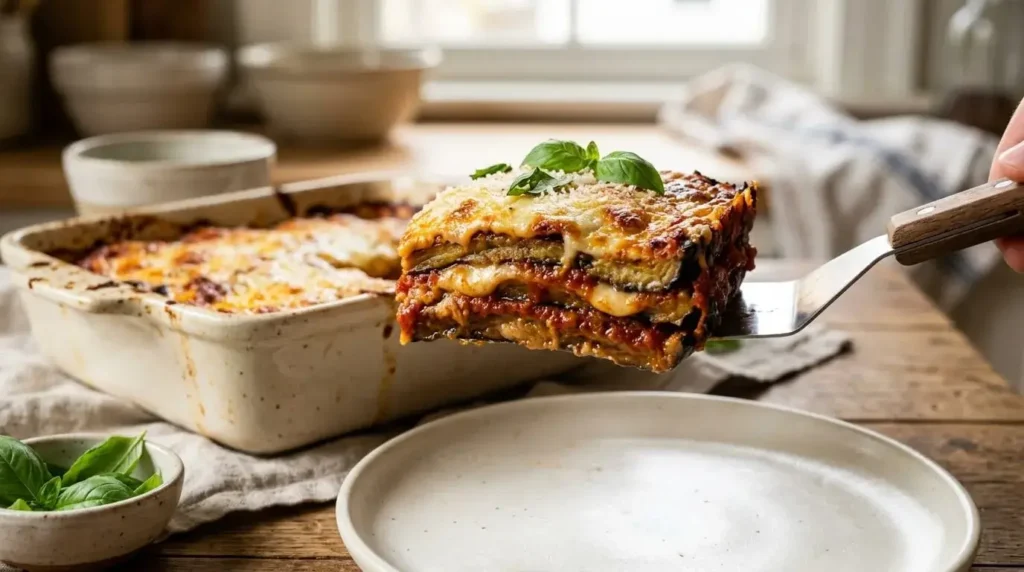
Bake covered until bubbling and heated through, then finish uncovered so the top browns properly. But let the casserole rest for at least 10-15 minutes before cutting. Then skipping this step is the single easiest way to end up with liquid pooling on the plate instead of clean slices.
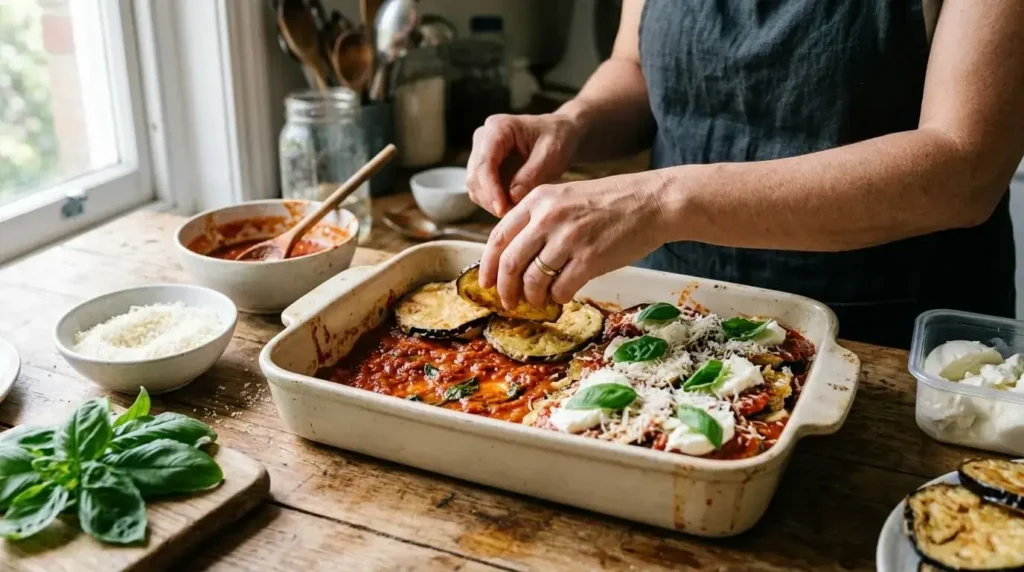
Honest Timing: How Long Does Eggplant Parmesan Take?
I want to be straightforward here, because a lot of recipes online quote timing that doesn’t hold up once you actually salt the eggplant and reduce a sauce properly. Between active prep, passive salting and resting and actual cook time, this dish realistically takes around 2 to 2½ hours from start to finish. Because you can shorten that meaningfully by using jarred sauce and skipping the salting step, but don’t expect a 45-minute weeknight version if you’re doing the full technique.
| Stage | Active time | Passive/oven time |
| Eggplant prep | 10 min | 30-45 min (salting) |
| Sauce | 10 min | 20-25 min (simmering) |
| Roasting | 5 min | 25-30 min |
| Assembly | 10 min | – |
| Final bake | – | 30-35 min |
| Rest | – | 10-15 min |
| Total | ~35 min active | ~2–2½ hours total |
This is a planning benchmark for testing. Final published timing should reflect actual kitchen results before you rely on it.
Troubleshooting Healthy Eggplant Parmesan
In testing this recipe, the moisture issues showed up almost immediately if any step got rushed – that’s really the throughline for most of the problems below.
| Problem | Likely cause | Fix | Prevention |
| Watery casserole | Wet eggplant, thin sauc, or undrained cheese. | Drain and blot excess liquid before serving; slice and serve with a slotted spoon. | Salt and dry eggplant fully; reduce sauce until thick; drain mozzarella. |
| Tough eggplant | Under-roasted slices. | Not fixable once baked – roast longer next time. | Roast until fully tender and lightly browned before assembly. |
| Bland flavor | Under-seasoned sauce or eggplant. | Add salt and a splash of good olive oil at the serving. | Season the sauce assertively; salt eggplant properly. |
| Pale top | Insufficient uncovered browning time. | Broil briefly at the end, watching closely. | Finish the bake uncovered for the last several minutes. |
| Greasy result | Excess oil or cheese. | Blot the top with a paper towel before serving. | Measure oil precisely; don’t overload cheese layers. |
| Collapsing layers | Too much moisture or insufficient rest. | Let it rest longer before the next slice. | Always rest at least 10-15 minutes before cutting. |
Is Eggplant Parmesan Healthy?
Eggplant itself is a low-calorie vegetable with fiber, but the overall dish is shaped by what surrounds it: olive oil, cheese and sodium from both the cheese and the tomato sauce. Moreover, a baked, lighter version like this one uses less oil than a fried preparation and measures cheese rather than piling it on, which helps – but the dish isn’t automatically low-calorie or a diet food just because it’s baked. Because portion size and what you eat alongside it matter as much as the recipe itself. The Harvard T.H. Chan School of Public Health’s Nutrition Source frames this kind of dish as one piece of a broader Mediterranean-style eating pattern built around daily whole grains, olive oil, fruits, vegetables, beans, nuts, herbs and spices, with animal proteins used in smaller amounts – not as a single “healthy food” on its own. The Nutrition Source
Is Baked Eggplant Parmesan Healthier Than Fried?
Roasting instead of frying meaningfully cuts down on oil absorption, which is a real difference. But “baked” doesn’t automatically mean low-calorie or low-sodium – cheese quantity, sauce sodium and portion size still drive most of the nutritional picture. Therefore, the American Heart Association notes that a Mediterranean-style eating pattern emphasizing vegetables, fruits, whole grains, beans, legumes and non-tropical oils while limiting added sugars, sodium and saturated fats is what supports heart health – not any single dish in isolation. Mayo Clinic
Storage, Reheating & Make-Ahead
Let the casserole cool before covering and refrigerating; leftovers keep for about 3-4 days. When reheating, the USDA Food Safety and Inspection Service recommends using a food thermometer to confirm leftovers reach 165°F throughout, whether you’re using an oven, stovetop, or microwave. Hence, the FDA also advises refrigerating or freezing perishable food within 2 hours of cooking. Then both the tomato sauce and the roasted eggplant can be made a day or two ahead and assembled just before baking. Further freezing works, but expect some texture loss in the eggplant once thawed. USDAAmazonaws
Quick reference:
- Refrigerate: 3-4 days.
- Reheat: To 165°F, checked with a food thermometer.
- Freeze: Possible, with some texture change.
- Best texture: Eaten fresh or refrigerated, not frozen.
What to Serve With Eggplant Parmesan
Keep the rest of the meal simple and Mediterranean. However, a crisp green salad with lemon and olive oil or a side of sautéed or roasted greens rounds the plate out without weighing it down. because roasted vegetables work well too. But if you want bread, a small piece of crusty bread for the sauce is a reasonable addition-just be mindful that eggplant Parmesan is already a substantial dish on its own, so a heavy pasta side isn’t necessary.
Frequently Asked Questions
Can eggplant Parmesan be healthy?
Yes, it can fit a balanced eating pattern, but it depends on preparation – roasting instead of frying, measured oil and cheese and reasonable portions all matter more than the dish’s name alone.
How do you make eggplant Parmesan healthier?
Roast the eggplant instead of frying, measure the olive oil, concentrate the tomato sauce, use cheese strategically rather than excessively and let the casserole rest before slicing.
Is baked eggplant Parmesan healthy?
Baking reduces oil absorption compared to frying, which helps. But it’s not automatically low-calorie – cheese, sodium sauce and portion size still shape the overall nutritional picture.
Can you make eggplant Parmesan without breadcrumbs?
Yes. This recipe is breadcrumb-free by default, which keeps it simpler and works for gluten-free diets. because breadcrumbs aren’t a universal authenticity requirement in traditional preparations.
Is eggplant Parmesan Sicilian or Neapolitan?
Both regions have strong claims and distinct versions. But Sicilian preparations often lean on caciocavallo and pecorino, while Campanian/Neapolitan versions favor fiordilatte – there’s no single “correct” regional answer.
Why is my eggplant Parmesan watery?
Usually wet eggplant, a thin sauce or undrained mozzarella. Salt and dry the eggplant thoroughly, reduce the sauce until thick, drain the cheese well and always rest the casserole before cutting.
How do you store and reheat eggplant Parmesan?
Refrigerate for 3-4 days in a covered container. Then reheat to an internal temperature of 165°F, checked with a food thermometer, per USDA guidance.
This lighter, healthy eggplant Parmesan won’t taste like a compromise – it’s built to give you tender roasted eggplant, thick tomato sauce and real cheese flavor, with the moisture control that keeps it from turning into a soupy mess. But if you make it, check out more Mediterranean recipes or explore Mediterranean cuisine by region for more Italian-inspired dishes. For more on the broader eating pattern this dish fits into, see our Mediterranean diet guide, brought to you by Mediterranean Cuisines.