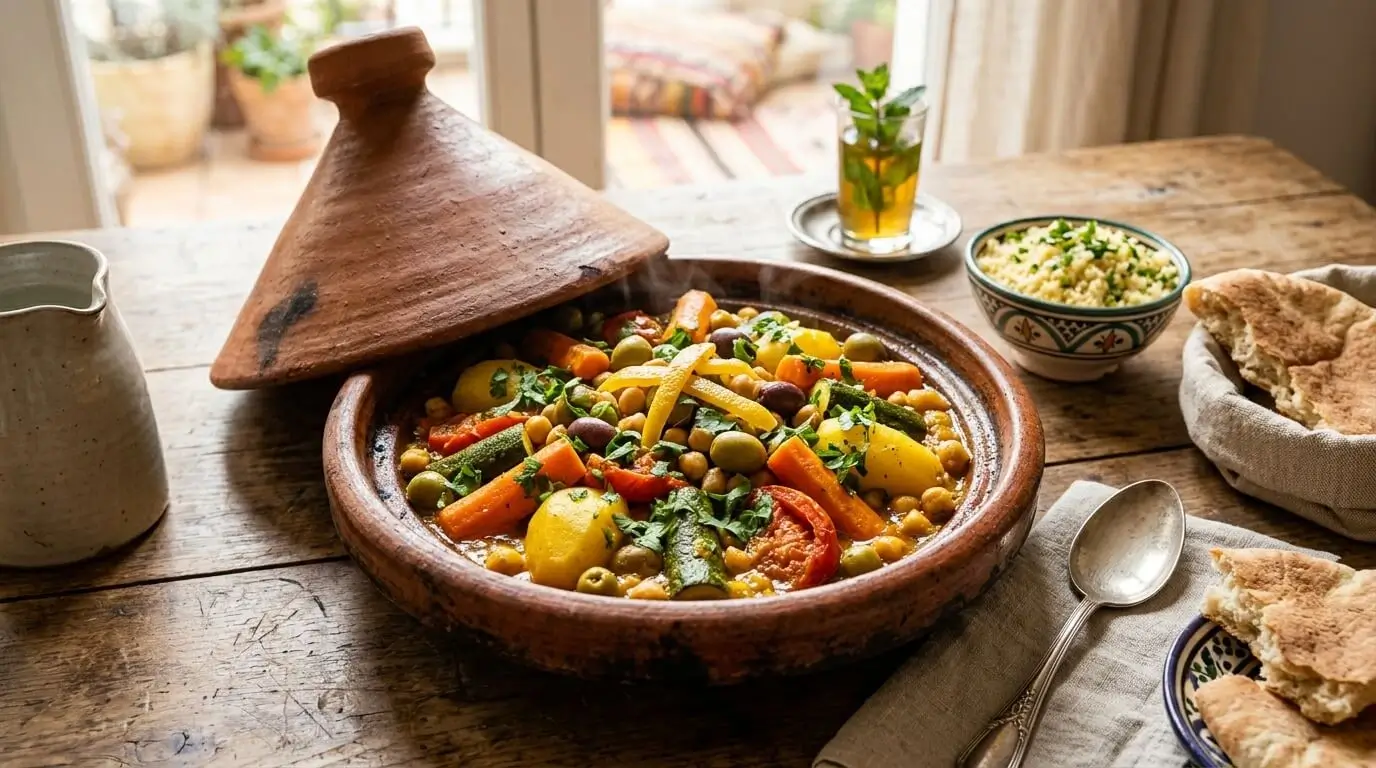
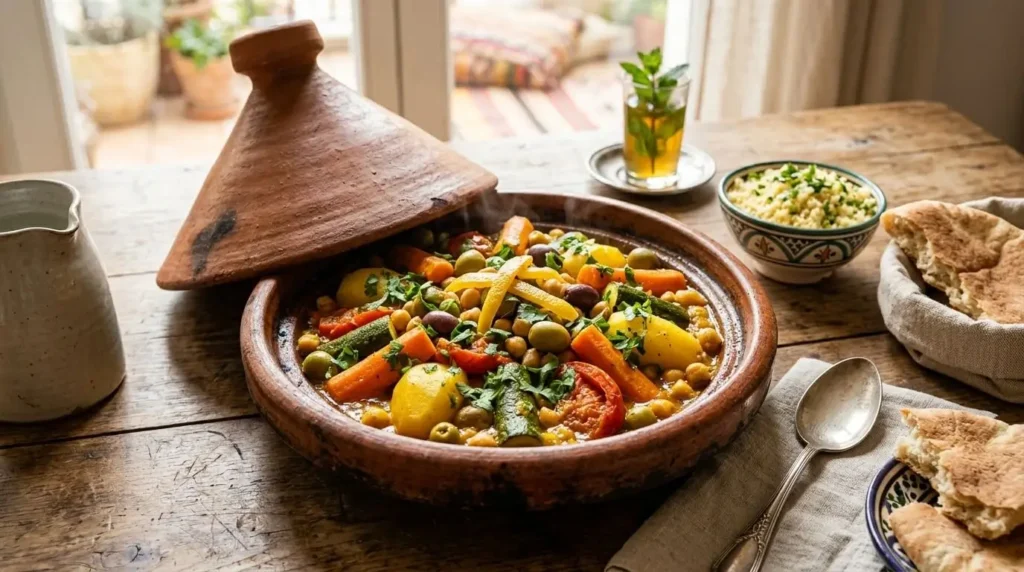
This vegetable tagine recipe is built the way Moroccan home cooks actually make it: vegetables layered instead of stirred, spices bloomed in oil before anything else goes in the pot and enough time given for everything to steam into tenderness. Therefore, you don’t need a clay tagine to get there – a Dutch oven works just as well – but you do need to know why each step matters and that’s what this guide walks you through.
Quick Answer
A vegetable tagine is a slow-cooked Moroccan stew of layered vegetables, chickpeas and warm spices, traditionally simmered in a cone-lidded clay pot that traps steam and concentrates flavor. Moreover, this version uses carrots, potatoes, zucchini, bell pepper and tomatoes with ras el hanout, cumin and preserved lemon. Overall, realistically, it takes about 1 hour 20 minutes from start to finish – 25 minutes of prep and about 55 minutes of mostly hands-off simmering. That’s why it’s ideal for a make-ahead vegetarian dinner and it works in a traditional tagine, a Dutch oven or any heavy lidded pot.
What Is a Vegetable Tagine?
A tagine is actually two things: the shallow clay pot with a tall, cone-shaped lid and the slow-cooked dish made inside it. Because the cone shape isn’t decorative – it condenses rising steam and channels it back down onto the food, which is why tagines cook with very little added liquid compared to a typical stew. Also, this vegetable tagine recipe is a plant-based North African main built on that same principle: layered vegetables and chickpeas steamed gently under a tight-fitting lid until they’re tender but still holding their shape, seasoned throughout with a warm and fragrant spice blend rather than heat-forward chili.
Why You’ll Love This Moroccan Vegetable Tagine
- Naturally vegetarian and easily vegan (just double-check your broth)
- Gluten-free as written, using pantry staples you can verify easily
- Freezer-friendly – makes a great make-ahead dinner
- Built from vegetables and canned chickpeas you can find at any US grocery store
- Deeply flavorful from bloomed spices, not from added heat or sugar
- Easy to adapt with whatever vegetables are in season
Ingredients You’ll Need
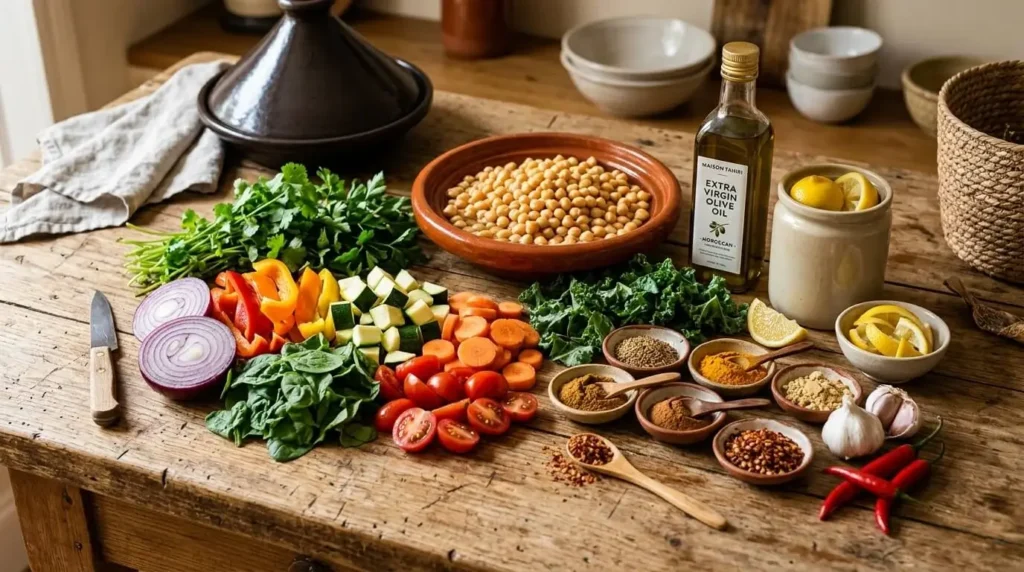
Vegetables
The backbone of the dish: onion and garlic for the base, then carrots, potatoes, zucchini, bell pepper and tomatoes layered on top. Then cut vegetables into similarly sized pieces so they cook at roughly the same rate.
Protein & Pantry Staples
Canned chickpeas add protein and body without extending the cooking time the way dried chickpeas would. Moreover, olive oil carries the spices and vegetable broth keeps everything moist without turning the dish watery.
Moroccan Spices
Ras el Hanout is the defining note here – a blended spice mix whose exact makeup varies from family to family and shop to shop, often containing anywhere from a dozen to more than twenty spices. Because cumin, coriander, paprika, turmeric and cinnamon round it out, giving the tagine its warm, slightly sweet-savory backbone.
Optional Authentic Ingredients
Preserved lemon is worth seeking out. It’s cured in salt and its own juice for weeks, which mellows the bitterness of fresh lemon peel into something rounder and more savory – a flavor you can’t fully replicate with fresh lemon. However, green olives and fresh cilantro or parsley are common Moroccan additions that finish the dish rather than season it during cooking.
Ingredient Substitutions
| Traditional | US Grocery Substitute | Flavor Difference |
| Preserved lemon | Fresh lemon zest and a pinch of extra salt. | Brighter, less rounded; missing the fermented depth. |
| Ras el hanout | Curry powder, cinnamon and extra cumin. | Close in warmth, but less complex and floral. |
| Fresh tomatoes | Canned diced tomatoes | Very close; canned can be slightly more acidic. |
| Green olives | Kalamata olives and rinsed | Milder brine flavor; slightly softer texture. |
| Vegetable broth | Water and 1 bouillon cube | Fine substitute; watch sodium levels. |
How to Make Vegetable Tagine
Prepare ingredients.
Cut all vegetables into similarly sized chunks before you start cooking – a tagine moves fast once the spices hit the pan and there’s no good moment to stop and chop mid-recipe.
Build a flavor base.
Warm the olive oil and soften the sliced onion, then add the garlic and all the spices together. Also cook them for about 30 seconds, just until fragrant. Because this step is called blooming: dry spices are fat-soluble, so a brief sizzle in warm oil releases far more of their aroma and flavor than adding them straight to liquid ever would. Then stir in the tomato paste to deepen the base further.
Layer vegetables correctly.
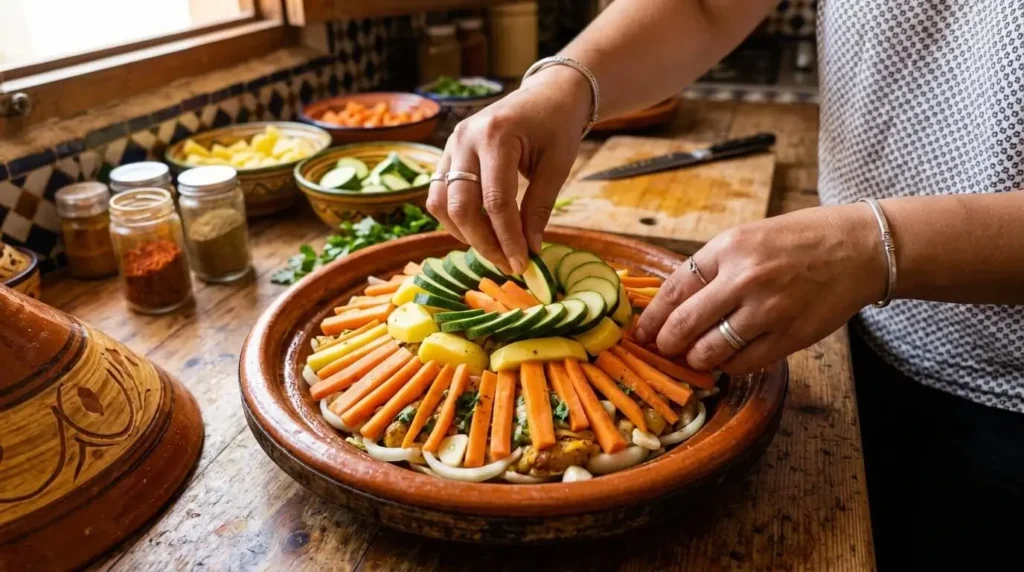
Add the vegetables in layers rather than dumping them in and stirring – root vegetables like carrots and potatoes go in first, closer to the heat, with quicker-cooking zucchini and bell pepper layered on top. That’s why this is the single biggest difference between an authentic tagine and a typical one-pot stew: stirring breaks vegetables down and turns everything into a uniform mush, while layering lets each vegetable cook gently in rising steam and keep its own texture and shape.
Slow simmer
Add the chickpeas, then pour the broth around the edges of the pot rather than directly over the vegetables – this preserves the steaming effect instead of turning the dish into a simmering liquid stew. Moreover, cover tightly and let it cook gently for about 50-55 minutes without lifting the lid or stirring.
Finish and garnish.
Stir in the preserved lemon during the final 10 minutes so its flavor stays bright rather than cooking away. Then finish with fresh cilantro and parsley and olives if using, right before serving.
A Note on Honest Timing: A lot of recipes online promise a vegetable tagine in 30-40 minutes. In my kitchen, that’s not enough time for potatoes and carrots to turn properly tender under a lid with minimal liquid – you either end up with crunchy vegetables or you crank the heat and lose the gentle steaming that makes a tagine taste like a tagine. Because give it the full 50-55 minutes of simmering. It’s mostly hands-off and the texture difference is worth it. Further, dried chickpeas add real time too: if you’re cooking them from scratch instead of using canned, budget an extra hour or more just for that step, done separately before you start the tagine itself.
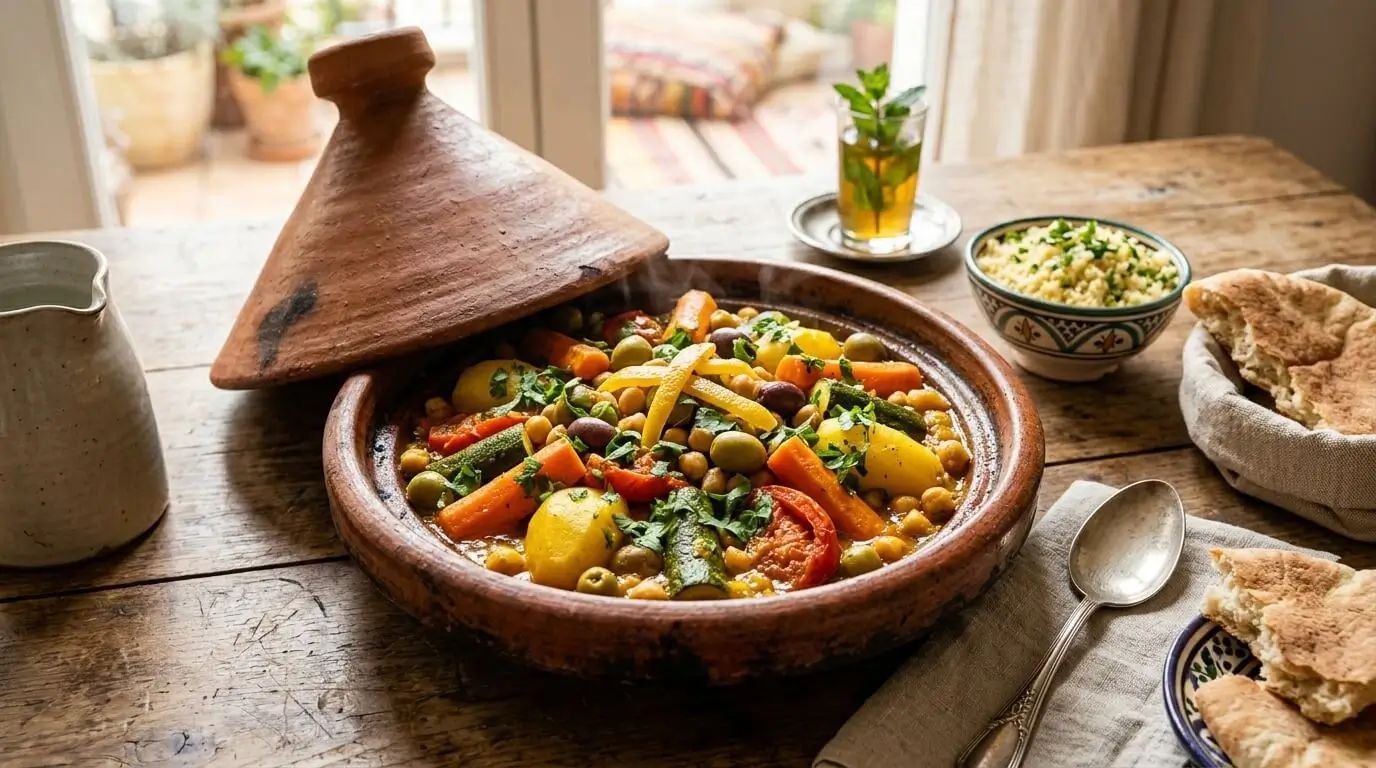
Moroccan Vegetable Tagine
Ingredients
Method
- Prepare and cut all vegetables.
- Warm olive oil and soften onions.
- Add garlic and spices; cook briefly until fragrant.
- Stir in tomato paste.
- Arrange vegetables in layers.
- Add chickpeas.
- Pour broth around – not directly over – the vegetables.
- Cover and simmer gently for about 50-55 minutes.
- Add preserved lemon during the final 10 minutes.
- Garnish with herbs before serving.
Notes
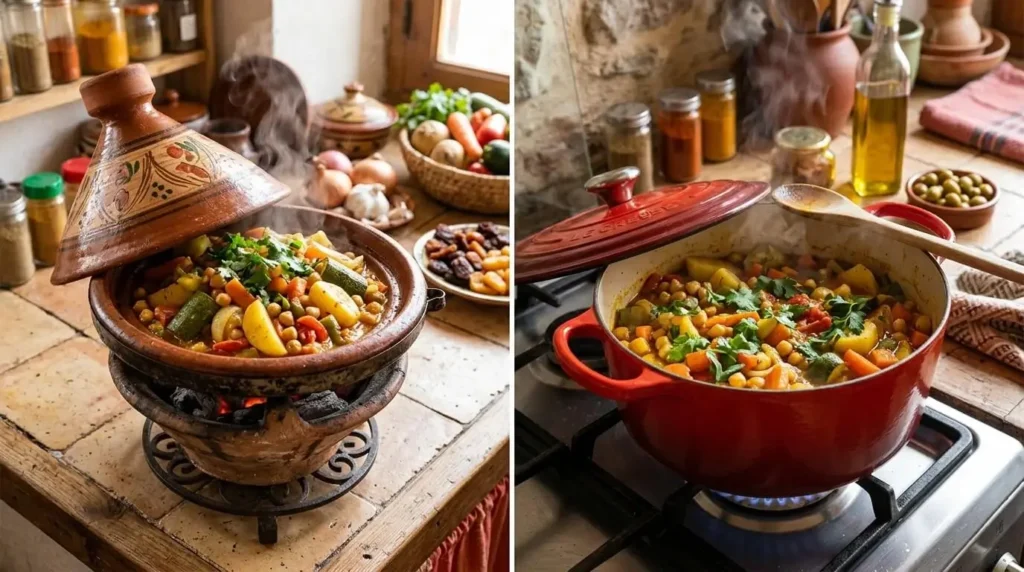
- Dutch oven adaptation: Use a heavy Dutch oven with a tight-fitting lid; cooking time is nearly identical to a traditional tagine.
- Traditional clay tagine instructions: Use low, even heat and avoid sudden temperature changes, which can crack unglazed clay. A diffuser between the tagine and the burner helps.
- Slow cooker adaptation (optional): Sauté the onion, garlic and spices on the stovetop first, then transfer everything to a slow cooker on low for 4-5 hours.
- Ingredient substitutions: See the substitution table above for preserved lemon, ras el hanout and other swaps.
- Vegan note: Already vegan as written, as long as your vegetable broth doesn’t contain animal-derived ingredients.
- Gluten-free note: Naturally gluten-free; just confirm your specific broth brand doesn’t add gluten-containing thickeners.
- Storage: Refrigerate in an airtight container for 3-4 days.
- Freezing: Freezes well for up to 3 months in a freezer-safe container.
Nutrition Estimate (Per Serving)
- Calories: 300-340
- Protein: 9-11 g
- Carbohydrates: 40-45 g
- Fiber: 9-11 g
- Fat: 11-13 g
- Saturated Fat: ~2 g
- Sodium: depends on broth used
Traditional Tagine vs. Dutch Oven
| Traditional Tagine | Dutch Oven | Heavy Pot | |
| Cooking time | Similar, sometimes slightly longer at low heat. | Similar; holds heat well. | Can run faster; watch for scorching. |
| Moisture retention | Excellent – cone lid maximizes steam return. | Very good with a tight lid. | Fair; may need a splash more broth. |
| Browning | Minimal – not built for searing. | Good if you search the onions first. | Good |
| Convenience | Requires more attention to heat level. | Easiest for most home cooks. | Works in a pinch |
| Flavor | Most traditional; subtly different texture. | Very close to traditional. | Slightly less concentrated. |
Tips for the Best Vegetable Tagine
- Resist the urge to stir once the lid goes on – let the layers do their job.
- Keep vegetable pieces a similar size so nothing overcooks before the rest is done.
- Go easy on the broth; too much liquid turns a tagine into a soup.
- Season gradually and taste again at the end, since spices intensify as they cook down.
- Let the tagine rest for 5 minutes off the heat before serving so the sauce settles.
- Add fresh herbs only at the very end so they stay bright, not wilted.
Common Mistakes to Avoid
| Mistake | Why It Happens | How to Fix It |
| Mushy vegetables | Stirring breaks vegetables apart during cooking. | Layer instead of stirring; use a gentle simmer. |
| Watery sauce | Too much broth added directly over vegetables. | Pour broth around the edges, not on top. |
| Bland flavor | Spices added without blooming or seasoned only at the end. | Bloom spices in oil early; taste and adjust as you go. |
| Burnt spices | Spices cooked too long or at too high heat. | Bloom for only 30 seconds over medium heat. |
| Undercooked potatoes | Simmer time cut short to match a faster recipe. | Give the full 5-5 minutes; potatoes need real time. |
What to Serve with Vegetable Tagine
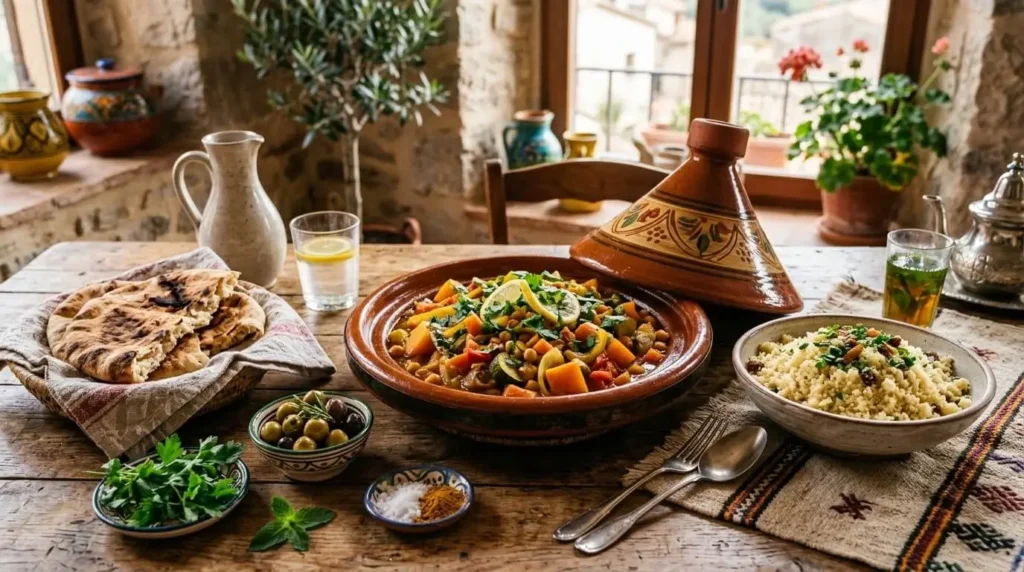
Couscous is the traditional pairing and does the best job of soaking up the sauce. Therefore, crusty bread or Moroccan flatbread (khobz) works well too, especially for scooping straight from a communal tagine. Then rice is a fine stand-in if couscous isn’t on hand and a dollop of plain yogurt alongside fresh herbs adds a cooling contrast to the warm spices.
- Weeknight: couscous, ready in under 10 minutes.
- Dinner party: khobz or another warm flatbread and served family-style.
- Traditional meal: couscous with a side of olives and mint tea.
- Vegetarian feast: pair with a second Mediterranean dish – browse more Mediterranean recipes for ideas.
A Brief Look at the Dish’s Moroccan Origins
The tagine’s clay-pot cooking method traces back to Berber (Amazigh) communities across North Africa, who used the cone-lidded pot as a practical answer to scarce fuel and water – steam-based cooking gets more out of less. because tagines have long been a fixture of everyday Moroccan home cooking rather than a special-occasion dish, with a version for nearly every household. Moreover, regional variations are common: coastal areas lean toward seafood tagines, while the interior favors vegetable and meat versions like this one, and the exact spice ratio in a family’s ras el hanout is often treated as a point of pride. Further, for more on the region’s cooking traditions, see our North African cuisine overview.
Storage, Freezing & Reheating
| Method | How Long | Best Practice |
| Refrigerator | 3-4 days | Store in an airtight container once cooled. |
| Freezer | Up to 3 months | Freeze in a freezer-safe container, leaving room for expansion. |
| Reheating | – | Warm gently on the stovetop with a splash of broth or microwave in short intervals. |
Follow the USDA’s guidance on leftovers and food safety for cooling and refrigeration timing and see Foodsafety.gov for general reheating and freezing safety guidelines.
Frequently Asked Questions
What exactly is vegetable tagine?
It’s a Moroccan stew of layered vegetables, chickpeas and warm spices, traditionally slow-cooked in a cone-lidded clay pot that traps steam. because the layering and gentle heat keep vegetables tender without turning mushy and the dish is typically served with couscous or bread.
What are the main ingredients of tagine?
Core ingredients include onions, garlic, root vegetables like carrots and potatoes, softer vegetables like zucchini and bell pepper, chickpeas, tomatoes, olive oil and a Moroccan spice blend called ras el hanout, often finished with preserved lemon and fresh herbs.
What are common mistakes when making tagine?
The most common mistakes are stirring too much (which breaks down vegetables), adding too much broth (which waters down the sauce) and rushing the simmer time, which leaves potatoes and carrots undercooked instead of properly tender.
What should you serve with vegetable tagine?
Couscous is the traditional pairing, since it absorbs the sauce well. Because crusty bread, flatbread or rice are all good alternatives and a side of plain yogurt or fresh herbs adds a cooling contrast to the warm spices.
Can I make vegetable tagine without a tagine pot?
Yes. A Dutch oven with a tight-fitting lid works very well and produces results close to a traditional clay tagine. Overall, any heavy pot with a good lid can work too, though you may need to watch moisture levels more closely.
Can vegetable tagine be frozen?
Yes, it freezes well for up to 3 months in an airtight, freezer-safe container. Therefore, cool it completely before freezing and reheat gently on the stovetop with a splash of broth to restore the sauce’s texture.
Is vegetable tagine vegan?
Yes, as long as the vegetable broth you use doesn’t contain any animal-derived ingredients, which is true of most store-bought vegetable broths. Double-check the label if you’re cooking for a strictly vegan household.
Can I prepare it ahead of time?
Yes. Vegetable tagine reheats well and, like many stews, can taste even better the next day once the spices have had time to settle into the vegetables. Also store it in the refrigerator and reheat gently before serving.
Conclusion
This vegetable tagine recipe rewards a little patience – give the vegetables their full simmer time, layer instead of stir and you’ll get a dish with real depth instead of a rushed weeknight stew. Moreover, I’ve made this one enough times to know the extra 15-20 minutes over other online versions is exactly what separates “fine” from genuinely good. Further, give it a try, leave a review with how it turned out for you and feel free to swap in whatever vegetables are in season.That’s why, for more dishes from this part of the world, explore our Greek recipes or browse the full Mediterranean Cuisines home page. You can also read more about the Mediterranean diet and how legumes and vegetables like the chickpeas in this dish fit into a healthy eating pattern.
[IMAGE 1: vegetable-tagine-recipe.jpg | Authentic Moroccan vegetable tagine recipe served in a traditional tagine | Vegetable Tagine Recipe | An authentic Moroccan vegetable tagine made with warming spices and seasonal vegetables. | Hero image showing the finished vegetable tagine served traditionally. — placement note: this hero image belongs immediately below the H1, at the top of the article]