Greek Baklava at a Glance
This baklava recipe layers crisp phyllo with coarsely chopped walnuts and almonds, warm cinnamon and cloves and a honey-lemon syrup – the flavor combination that marks it as genuinely Greek rather than just “Greek-style” in name only. Furthermore, it’s a make-ahead dessert: real active work is under an hour, but the baklava needs time afterward to become what it’s supposed to be.
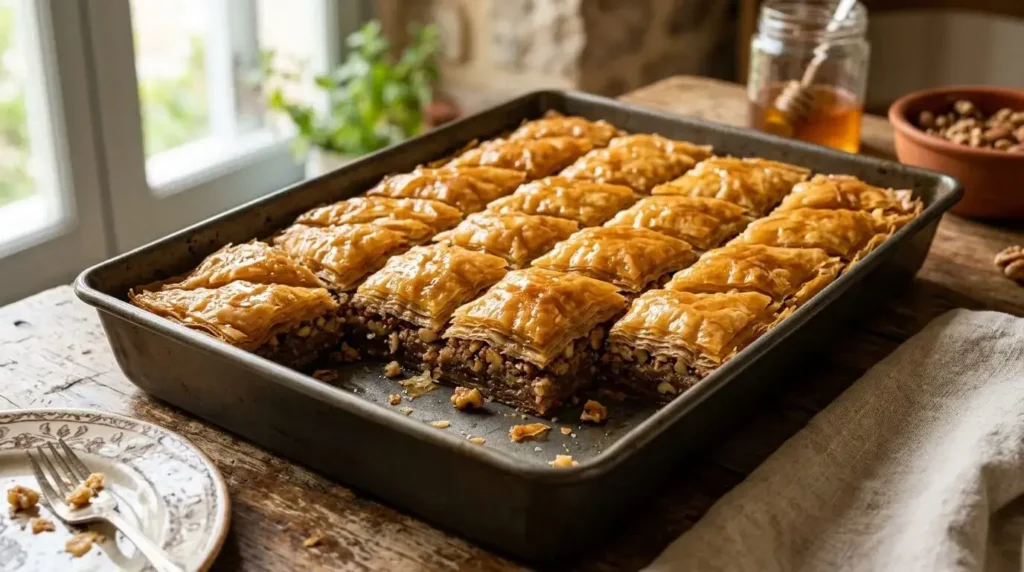
Quick Answer: Greek Baklava
This Greek baklava recipe layers crisp phyllo with coarsely chopped walnuts and almonds, warm cinnamon and cloves and a honey-lemon syrup. Then plan for about 45 minutes of active preparation, 45 minutes of baking and at least 6 hours of resting. Thaw the phyllo in the refrigerator 24 hours ahead. Yield: 24 pieces.
What Makes This a Greek Baklava Recipe?
“Baklava” isn’t one dish – it’s a family of desserts and each region built its own version. But here’s what specifically makes this one Greek.
The Greek flavor profile
Greek baklava leans on walnuts as the primary nut, with almonds as a traditional secondary player – a noticeably different combination from the pistachio-forward baklava you’ll find in Turkish bakeries. Because the syrup is honey-forward rather than plain sugar syrup and it’s warmed through with cinnamon and cloves, brightened with lemon . However, some Greek households also fold in dry breadcrumbs or crushed rusks (paximadi) between the nut layers, a traditional touch that helps the filling hold together and soak up syrup evenly.
Greek vs. Turkish vs. Lebanese baklava
None of these traditions is more “real” than the others – they’re distinct regional expressions of a shared pastry idea. But here’s a quick orientation:
| Feature | Greek | Turkish | Lebanese |
| Typical nuts | Walnuts and almonds. | Pistachios. | Mixed nuts. |
| Sweetener | Honey-forward. | Sugar-forward. | Sugar syrup. |
| Flavor profile | Cinnamon and cloves. | Minimal spic. | Rose/orange blossom. |
| Identity | Warm, honeyed. | Pistachio-forward | Floral. |
You can find Greek recipes across the site if you want to explore more of this style before you dive in.
Ingredients You Need
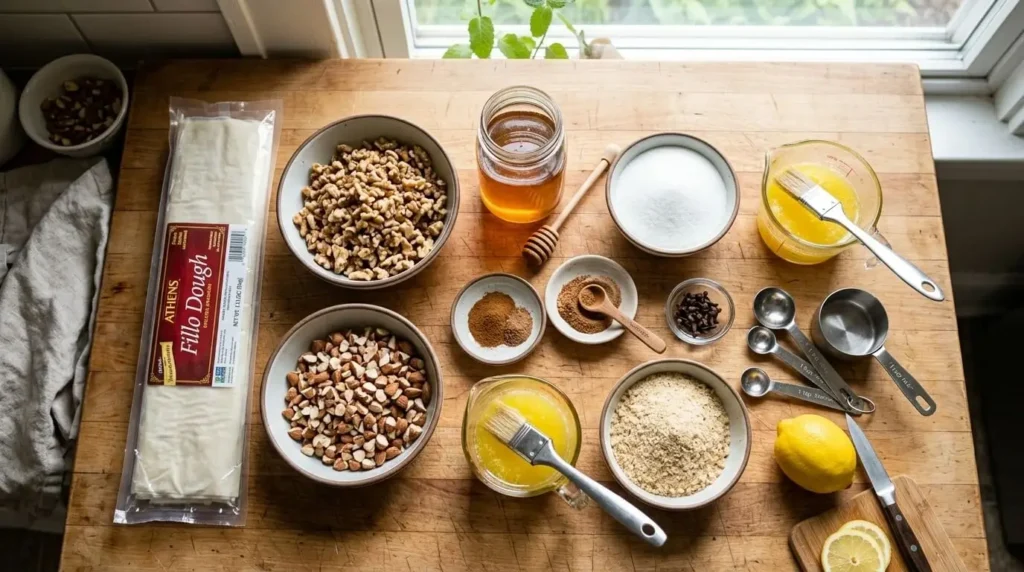
Nuts and filling
Walnuts do most of the work here, with almonds adding a firmer bite and a little sweetness. Therefore, chop them coarsely – pulse a few times in the food processor and stop while you can still see distinct pieces. When ground to a powder, the filling turns pasty and loses the texture that makes each bite interesting. Hence, cinnamon and cloves go into the filling itself, not just the syrup, so every layer carries some spice.
Phyllo, butter, and syrup
Frozen supermarket phyllo works fine for this recipe – you don’t need to hand-stretch dough to get authentic results. Because melted unsalted butter brushed between every sheet is what gives baklava its shatter-crisp layers, clarified butter is worth trying if you want an even cleaner flavor and less risk of soggy spots from milk solids. Moreover, the syrup itself is built from honey, sugar, water, lemon juice and warm spices – it’s what actually defines this as Greek baklava rather than a generic version.
US grocery substitutions
Traditional Greek ingredients aren’t always sitting on US shelves. But here’s what to reach for instead and what you’re trading off:
| If you can’t find… | Use… |
| Greek thyme honey. | Mild wildflower or clover honey. |
| Specialty Greek butter. | Unsalted butter. |
| Greek-style rusks. | Plain dry breadcrumbs or zwieback-style crumbs. |
| Specialty phyllo. | Standard supermarket frozen phyllo. |
These substitutes are practical, not identical – a Greek thyme honey has a floral depth a supermarket clover honey won’t fully replicate, but the recipe will still work and taste good.
Before You Start: Timing, Phyllo & Equipment
The honest timing
Most baklava recipes online quote 20 to 30 minutes of prep and leave it at that. But in my testing, that number only covers the time spent actively layering – it skips the phyllo thaw and, more importantly, the hours the baklava needs to rest before it’s actually ready to eat. Then here’s the real breakdown:
| Stage | Realistic time |
| Phyllo thawing | 24 hr advance |
| Active prep | ~45 min |
| Baking | ~45 min |
| Resting | ~6 hr |
| Total | ~7 hr 30 min |
The 24-hour phyllo thaw happens in the fridge while you’re doing other things – it’s not active work, but it does mean this isn’t a same-day dessert if your phyllo is frozen.
Equipment checklist
- 9×13-inch baking pan.
- Pastry brush.
- Sharp knife.
- Saucepan (for the syrup).
- Food processor (for chopping nuts).
- Cooling rack.
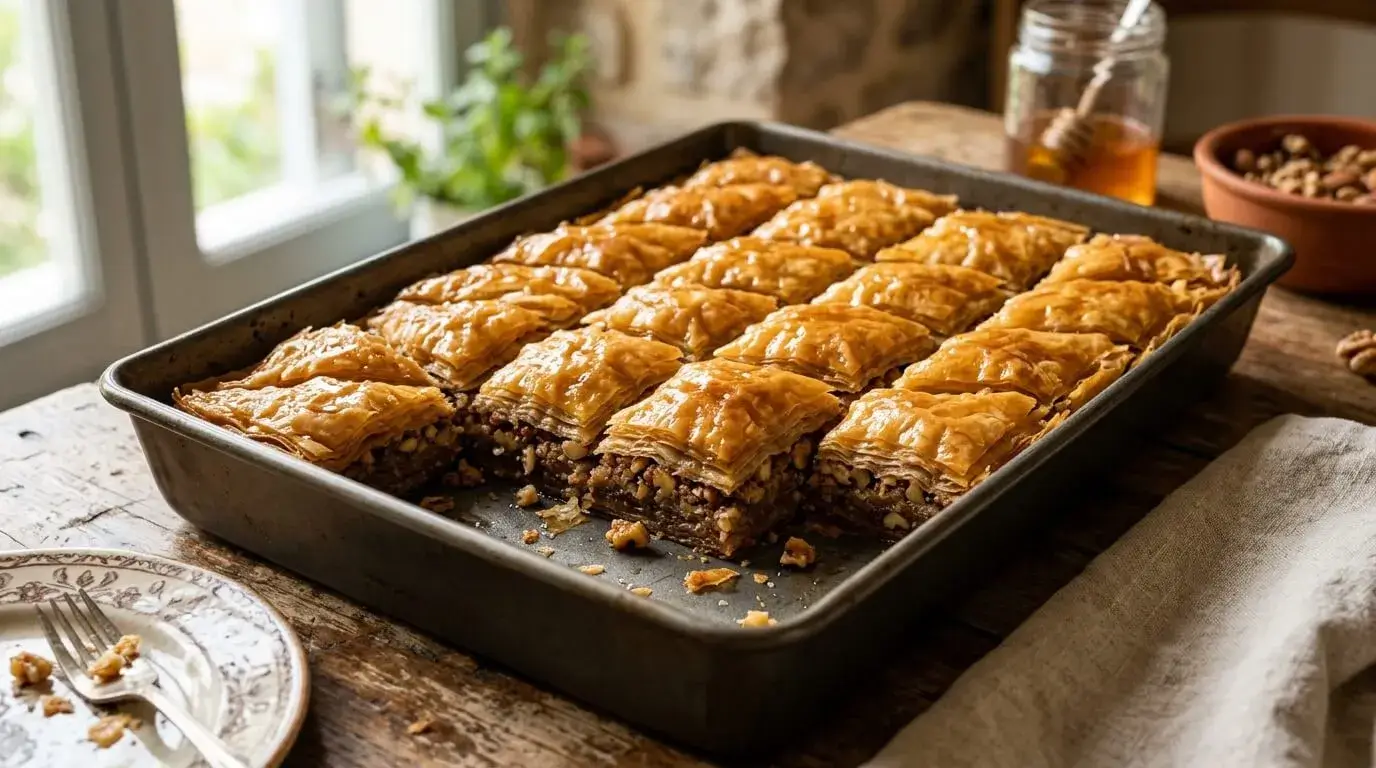
Greek Baklava
Ingredients
Method
Notes
- Thaw phyllo in the refrigerator 24 hours ahead.
- Keep unused phyllo covered with a damp, not wet, towel.
- Coarsely chop the nuts; do not grind them into a paste or powder.
- Cut the baklava before baking.
- Use cooled syrup over hot baklava for this recipe.
- Do not rush the resting period.
- For the best texture, rest at least 6 hours; overnight is ideal.
- Store so air can circulate rather than sealing warm baklava in an airtight container.
- If Greek thyme honey is unavailable, use a mild wildflower or clover honey.
- This card reflects the test formulation and must be updated after kitchen testing.
-
Nutrition
Estimated ~325 calories per piece (24 servings), based on the test formula above. This must be replaced with WP Recipe Maker’s calculated nutrition after the final formula is tested – do not publish this estimate as final.
How to Make Greek Baklava Step by Step
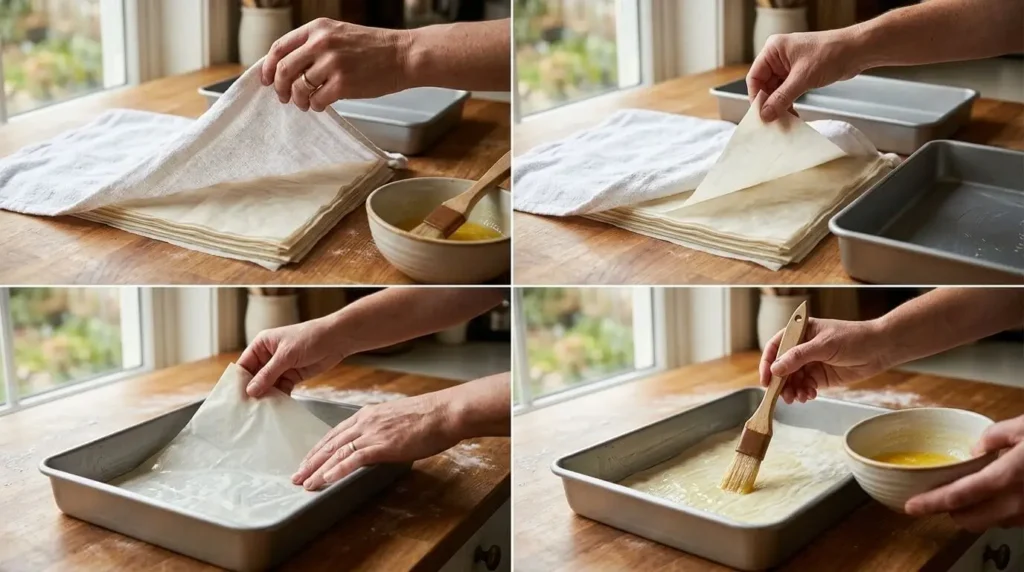
1. Thaw and prepare the phyllo
Move the phyllo from the freezer to the refrigerator 24 hours before you plan to bake. Once thawed, keep the sheets you’re not using under a slightly damp towel – phyllo dries out and cracks within minutes of open air. However, if a sheet tears, don’t worry; patch it in place and keep going. But nobody will see it once the baklava is assembled.
2. Make the Greek honey syrup
Combine sugar, honey, water, lemon juice, a cinnamon stick, cloves and a strip of citrus zest in a saucepan. However, simmer until the sugar dissolves and the syrup thickens just slightly – it should still pour easily. That’s why make this early: it needs to cool completely before it goes anywhere near the hot baklava, so give it time on the counter while you handle the rest of the recipe.
3. Prepare the walnut-almond filling
Combine the coarsely chopped walnuts and almonds with cinnamon, cloves and a little nutmeg. Therefore, keep the texture chunky rather than fine – this is what gives the finished baklava some bite instead of turning the filling into paste once it’s baked and syruped.
4. Build the phyllo layers
Lay 8 to 10 sheets of phyllo in the buttered pan, brushing each one lightly and evenly with butter before adding the next – don’t skip sheets or leave dry patches. alsoSpread the nut filling across 3 to 5 layers as you go, distributing it evenly rather than piling it thick in one spot. Then finish with 6 to 10 more buttered sheets on top. Because a well-built layer looks glossy and even, not soggy or dry – you should see a thin, uniform sheen of butter on each sheet before the next one goes down.
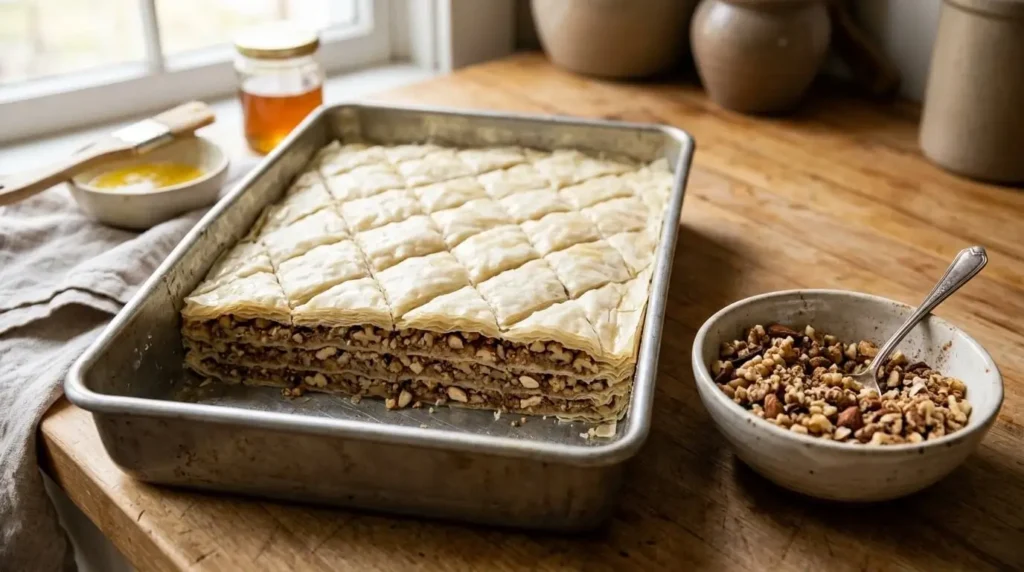
5. Cut the baklava before baking
Cut all the way through the layers into diamonds before it goes in the oven, not after. Hence, baked phyllo shatters if you try to cut it cold and pre-cutting also gives the syrup clear channels to soak into later.
6. Bake until deeply golden
Bake at 350°F for about 45 minutes, rotating the pan halfway through for even color. But don’t rely on the timer alone – look for deep golden color across the whole top, a crisp surface, edges just beginning to pull from the pan and a nutty aroma filling the kitchen. Then those cues matter more than the clock.
7. Pour on the syrup and let it rest
The moment it comes out of the oven, pour the cooled syrup slowly over the hot baklava, working it into the cut lines. That’s why You’ll hear it sizzle – that’s exactly what you want . Then leave the pan uncovered while it cools and absorbs.
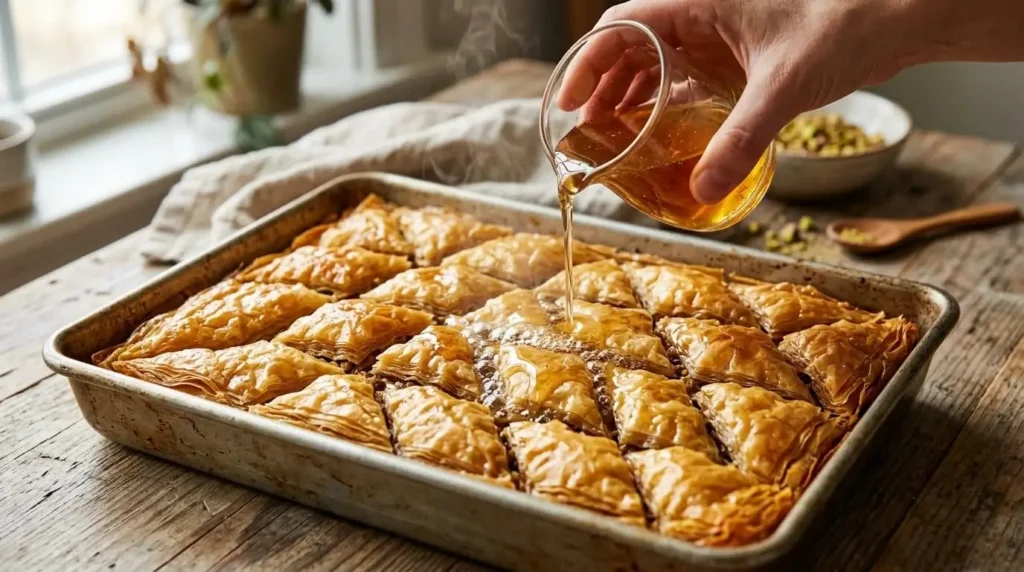
The Syrup Technique That Makes or Breaks Baklava
How thick should baklava syrup be?
You’re aiming for a syrup that coats a spoon lightly and still pours easily – not watery, not gluey.
- Too thin → the syrup won’t cling to the layers and the baklava can end up under-flavored.
- Over-reduced → the syrup turns heavy and pools instead of soaking in evenly.
- Right consistency → coats the spoon lightly and pours in a steady stream.
Hot syrup or cold syrup?
For this recipe, I pour cooled syrup over hot baklava straight from the oven. Because the temperature contrast is what drives the syrup down into the layers instead of just sitting on top. That said, you’ll find recipes – including some very good ones – that do the reverse and pour hot syrup over cooled baklava. Moreover, both methods have their defenders; this is simply the one that’s worked most consistently in my kitchen.
Why Baklava Needs to Rest
When can you cut and serve it?
Give it at least 4 hours before serving. However, Overnight is better and it’s genuinely worth the wait.
What changes while it rests?
This is the step most recipes rush past. But during those hours, the syrup works its way fully into the layers, the structure sets so the pieces hold together when lifte- and the texture finishes developing – a crisp, flaky exterior over a moist, syrup-soaked interior. Then cut into it too early and you’ll get a baklava that’s crisp on top but underdeveloped underneath.
Troubleshooting Greek Baklava
If your baklava is soggy
The most likely culprits are underbaking, too much syrup for the pan, syrup that was too hot when it went on or covering the pan before it had time to breathe.
If your baklava is dry
This usually means not enough syrup was used, it wasn’t poured evenly across the pan, the baklava was overbaked or it didn’t get enough resting time to absorb the syrup it did get.
If the syrup isn’t absorbing
Check three things: was the baklava hot enough when the syrup went on, was the syrup itself the right consistency and did you pour it into the cut lines rather than just over the top? Also, give it more resting time before assuming something went wrong.
If the phyllo tears
A torn sheet here and there isn’t a problem – patch it with a scrap piece and keep layering. Because it won’t show once the baklava is baked and cut.
If the top browns too quickly
Tent the pan loosely with foil partway through baking so the interior can catch up without the top scorching.
Storage, Reheating & Make-Ahead
How to store baklava
Store it at room temperature in a container that lets a little air circulate rather than sealing it airtight while it’s still warm, which traps moisture and softens the layers. Moreover, if you do refrigerate any portion, keep refrigerated foods at 40°F or below and follow the two-hour rule for foods that need refrigeration. Therefore, baklava also freezes well for longer storage.
How to reheat baklava
A few minutes in a low oven (around 300°F) will bring back some crispness without melting the syrup into a mess – skip the microwave, which turns the phyllo soft.
Make-ahead timeline
Day before: thaw the phyllo and optionally make the syrup ahead of time. Day of: assemble, bake, add the syrup and let it rest – ideally overnight before serving.
How to Serve Greek Baklava
Best serving temperature
Serve at room temperature or just slightly warm – straight from the refrigerator mutes both the flavor and the texture.
What to serve with baklava
Greek coffee is the classic pairing, but any unsweetened coffee or espresso works well against the sweetness. Furthermore, keep portions small; baklava is rich and a little goes a long way.
A Short Note on Baklava’s Origin
Baklava’s exact origins are genuinely disputed among food historians and no single country can claim to have invented it outright. However, layered pastries sweetened with nuts and honey appear in various forms across the ancient Mediterranean and Near East, but the version closest to what we recognize as baklava today developed significantly during the Ottoman Empire, whose palace kitchens are well documented as a center of its refinement. Moreover, from there, Greek, Turkish, Lebanese and other regional traditions each shaped their own distinct approach – which is exactly why the flavor profiles differ as much as they do.
Frequently Asked Questions About Baklava
What are the ingredients for baklava?
Phyllo dough, chopped nuts, butter and a sugar or honey syrup are the core components. Because this Greek version uses walnuts and almonds, cinnamon, cloves and a honey-lemon syrup for a warm, honeyed flavor.
What nuts are used in Greek baklava?
Walnuts are the primary nut in Greek baklava, often combined with almonds. However, this differs from Turkish baklava, which typically features pistachios as the star ingredient.
Is baklava Greek or Turkish?
Neither claims sole ownership. Therefore, baklava’s origins are disputed and span several culinary traditions, with the Ottoman Empire playing a major documented role in its development across the region.
Do you cut baklava before or after baking?
Cut it before baking, all the way through the layers. However, this makes clean diamond shapes possible and gives the syrup clear channels to soak into once the baklava comes out of the oven.
How long does baklava need to sit before serving?
At least 4 hours, though overnight is ideal. Moreover, this resting time lets the syrup fully absorb and the texture develop its proper crisp-outside, moist-inside contrast.
Does baklava need to be refrigerated?
Not necessarily for room-temperature storage in the short term, but any portion you refrigerate should be kept at 40°F or below and moved to the fridge within two hours if left out.
How do you keep phyllo dough from drying out?
Keep unused sheets covered with a slightly damp towel at all times while you work and work quickly once the phyllo is out of its packaging.
Why is my baklava soggy?
Usually underbaking, too much syrup, syrup applied too hot or covering the pan before it’s had time to breathe and absorb properly.
Final Recipe Notes
Plan ahead, don’t rush the resting period and serve at room temperature. But this one’s worth the wait – especially with a cup of Greek coffee alongside it.