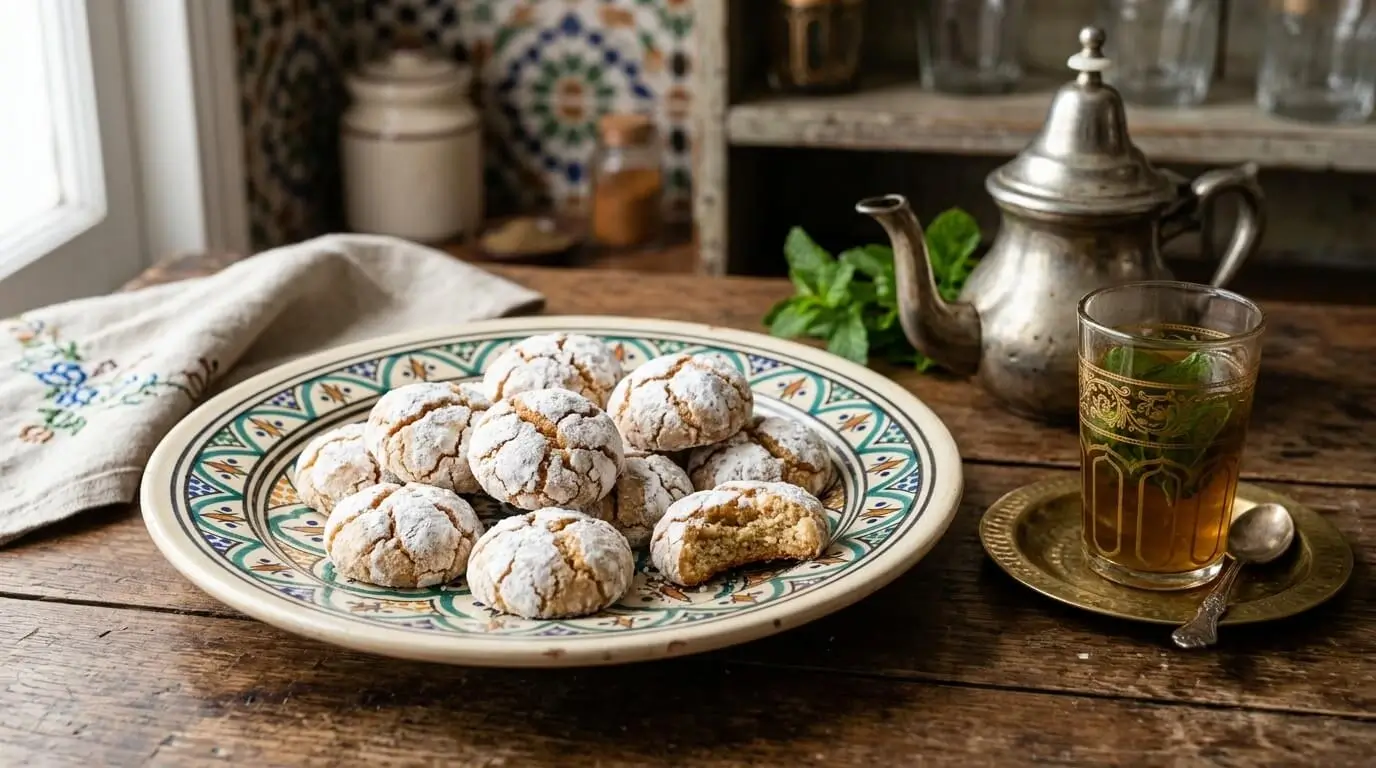
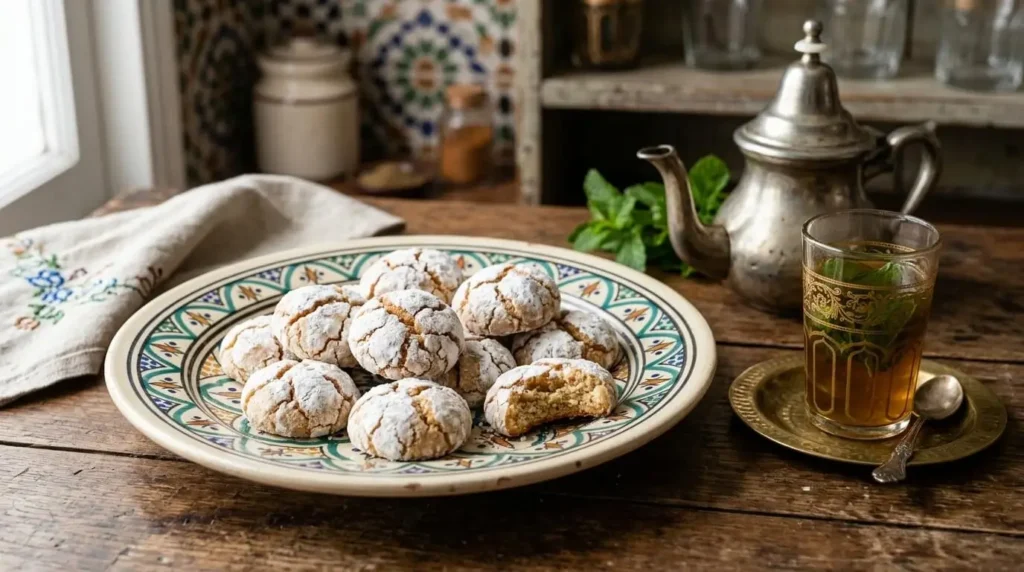
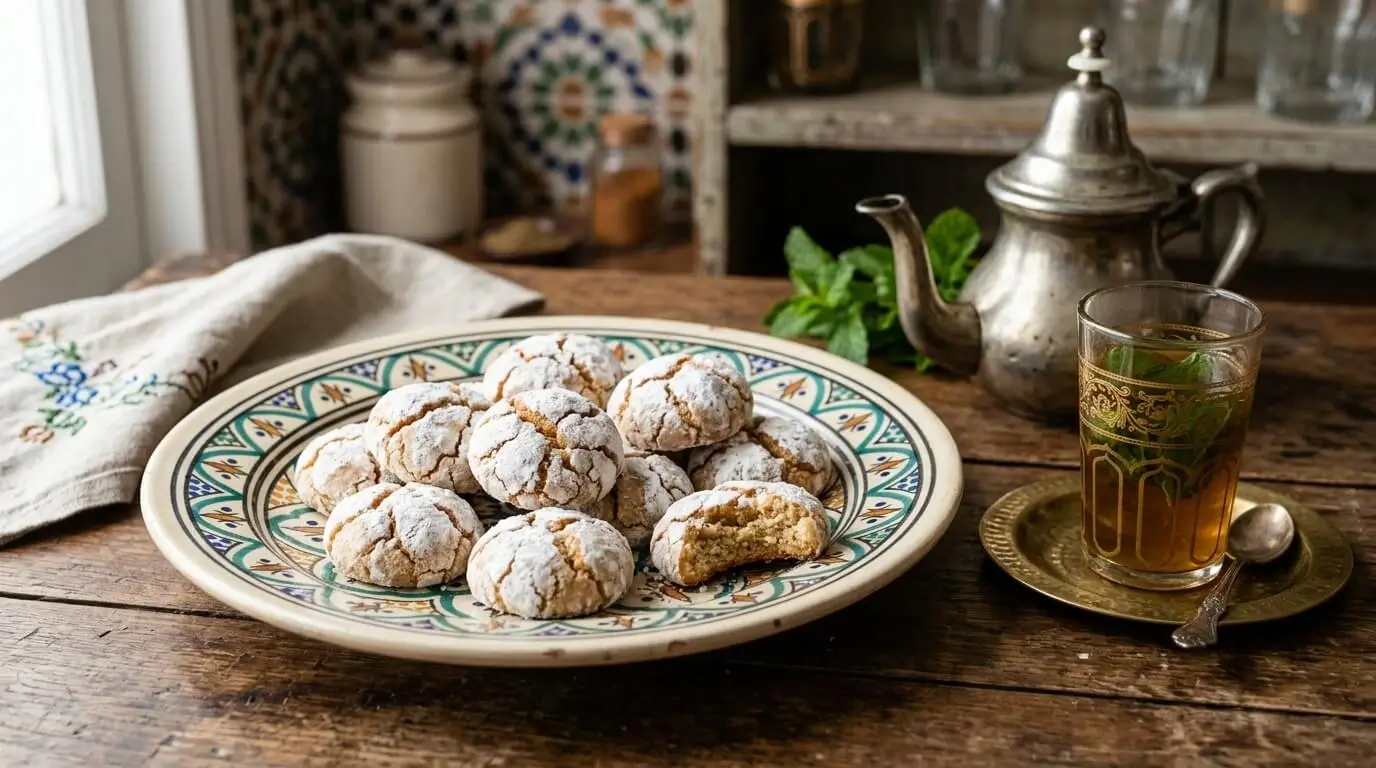
This Moroccan almond cookies recipe makes almond ghriba: small, round cookies with a cracked powdered-sugar crust and a tender, dense almond center. Moreover, they’re a fixture of Moroccan tea time, traditionally served alongside Mediterranean cuisines, mint tea rather than as a stand-alone dessert. Then below you’ll find the full method, the reasoning behind each step and the tested recipe card.
Quick Answer Box: Moroccan Almond Cookies at a Glance
| Question | Quick Answer |
|---|---|
| What are they? | The Moroccan almond ghriba. |
| Texture | Crackled exterior, tender/dense almond center. |
| Main ingredient | Ground blanched almonds or almond flour. |
| Signature flavor | Almond with citrus and orange blossom notes. |
| Best pairing | Moroccan mint tea. |
| Difficulty | Easy, with a shaping step that takes a little practice. |
| Total time | [FINAL TESTED VALUE REQUIRED]. |
| Gluten-free? | [FINAL TESTED VALUE REQUIRED – confirm once ingredient list and cross-contact are finalized]. |
What Are Moroccan Almond Cookies?
“Moroccan almond cookies” almost always refers to almond ghriba, sometimes called ghriba dyal louz. However, ghriba is a broad family name for Moroccan cookies, not a single recipe – you’ll find ghriba made with semolina, flour, sesame, coconut, almonds and they can look and taste quite different from one another. Because this recipe is specifically the almond version: a dense, ground-almond dough rolled in powdered sugar and baked until the surface cracks while the inside stays soft. Further, if you’ve seen “ghriba” used to describe a completely different cookie, that’s not a contradiction – it just means you’ve run into a different member of the same family.
Ghriba vs. Other Moroccan Cookies
Almond ghriba isn’t the only cookie that goes by a similar name and it’s worth knowing the difference before you start baking.
| Cookie | Key distinction |
| Almond ghriba | Ground-almond-based, round and crackled. |
| Ghriba Bahla | Different style, commonly flour/semolina/sesame-based. |
| Moroccan almond crescent cookies | Crescent-shaped, made with a separate butter-and-flour dough. |
| Kaab el Ghazal | Almond-filled pastry rather than a cookie. |
Why These Moroccan Almond Cookies Work
The texture of a good almond ghriba comes down to a handful of controllable factors, not luck. Therefore, an almond-heavy dough with the right moisture level holds together without becoming greasy or crumbly. Because a generous powdered-sugar coating isn’t just for looks – it’s what allows the surface to crack cleanly as the cookie expands slightly in the oven. And a short, closely watched bake keeps the center soft instead of drying it out. Hence, the cracks you see on a finished ghriba are the goal, not a sign that something went wrong.
For the right texture:
- Use finely ground almonds or almond flour, not a coarser almond meal.
- Keep the dough soft and slightly sticky rather than stiff.
- Coat each ball thoroughly in powdered sugar before baking.
- Pull the cookies while the centers still look underbaked.
Ingredients for Moroccan Almond Cookies
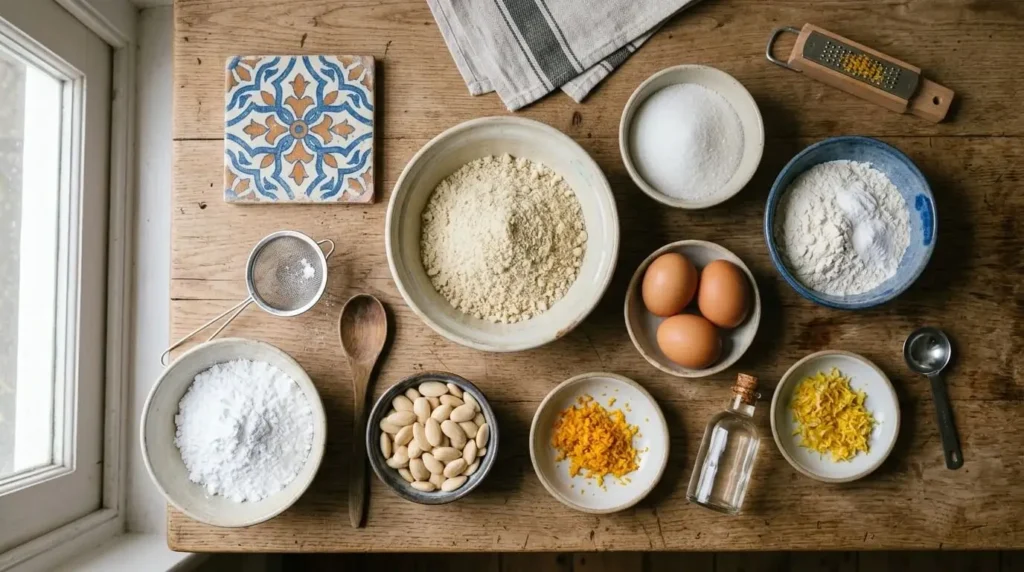
Almond ghriba has a short ingredient list, but each component has a specific job. Moreover, the almonds provide both structure and flavor, since there’s little or no wheat flour to fall back on. However, sugar sweetens the dough itself, while the powdered-sugar coating handles both sweetness and the visual crackle. Because eggs bind everything together, and a small amount of leavening (if the tested formula uses it) helps the cookies set without spreading. But the flavoring – orange blossom water, citrus zest or both – is what pushes the cookie from “generic almond cookie” toward something recognizably Moroccan.
Almond Flour vs. Almond Meal
These aren’t interchangeable in this recipe. The blanched almond flour is made from skinless almonds ground fine and pale; it gives the dough a smoother texture and the classic light color under the sugar coating. Furthermore, almond meal is typically coarser and includes the skins, producing a heavier, speckled cookie with a slightly different bite. Because this recipe is built around finely ground blanched almonds or almond flour – [FINAL TESTED VALUE REQUIRED: confirm which was used].
Orange Blossom Water, Citrus & Flavorings
Orange blossom water is one of the most common flavorings in almond ghriba, adding a floral note that citrus zest alone doesn’t replicate. Moreover, zest from an orange or lemon can supplement or, if orange blossom water isn’t available, stand in for part of that flavor, though the result will taste noticeably different. Also, use orange blossom water sparingly – a little goes a long way and too much can make the cookies taste more like perfume than pastry.
| Ingredient | What it does | Best choice | US substitute |
| Almonds | Structure, flavor. | Finely ground blanched almonds. | Store-bought blanched almond flour. |
| Orange blossom water | Floral aroma. | Culinary-grade orange blossom water. | Citrus zest (different flavor, not identical). |
| Citrus zest | Brightness. | Fresh orange or lemon zest. | Bottled zest, used sparingly. |
| Powdered sugar | Coating and crackle. | Fine and uncompacted powdered sugar. | None recommended. |
How to Make Moroccan Almond Cookies
1. Mix the Almond Dough
Combine the ground almonds, sugar and any leavening, then work in the eggs and flavorings until the dough comes together. That’s why it should be soft and slightly sticky – cohesive enough to hold a shape, but not dry or crumbly like a flour-based cookie dough.
2. Rest the Dough
If the tested formula calls for a rest, let the dough sit briefly before shaping. Moreover, this gives the almonds time to hydrate fully and makes the dough easier to portion cleanly. but [FINAL TESTED VALUE REQUIRED: confirm rest time, if any]
3. Shape the Cookies
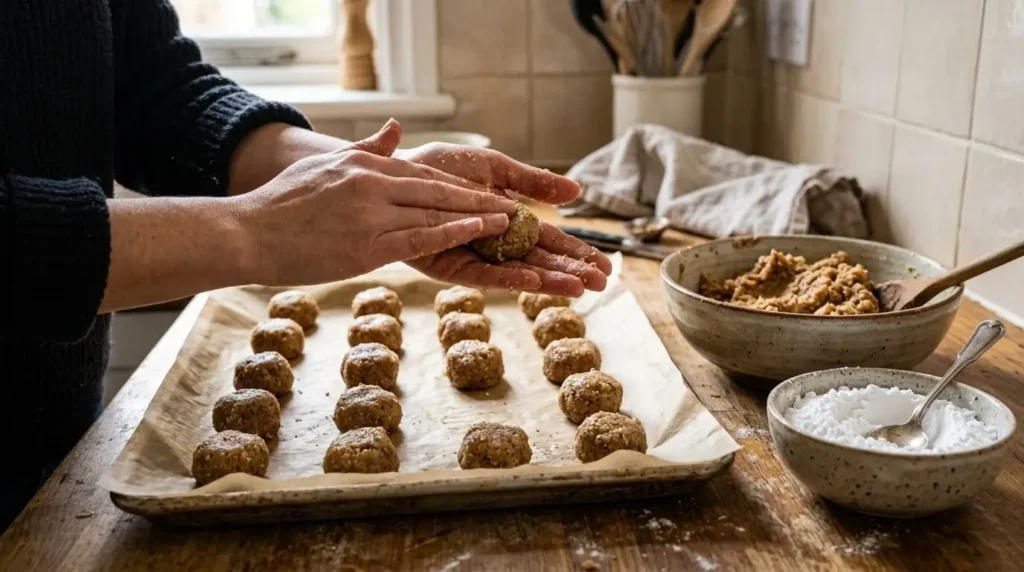
Portion the dough into evenly sized balls – [FINAL TESTED PORTION SIZE REQUIRED] – and roll each one smooth between your palms before coating.Then even sizing matters here, since uneven balls bake and crack inconsistently.
4. Coat Generously in Powdered Sugar
Roll each ball in powdered sugar until it’s fully and thickly covered. Because this isn’t a light dusting – a generous coating is what produces the deep, well-defined cracks that define the finished cookie.
5. Bake Until Cracked but Still Tender
Bake at [FINAL TESTED VALUE REQUIRED] for [FINAL TESTED VALUE REQUIRED], until the surface has cracked and the base and edges look set. Then the centers should still look slightly underbaked when you take the tray out – that’s correct, not a mistake.
6. Cool Before Moving
Let the cookies sit on the tray for a few minutes before transferring them. That’s why they’re fragile straight out of the oven and firm up considerably as they cool, so moving them too soon can cause them to break.
How to Get the Signature Cracks and Tender Center
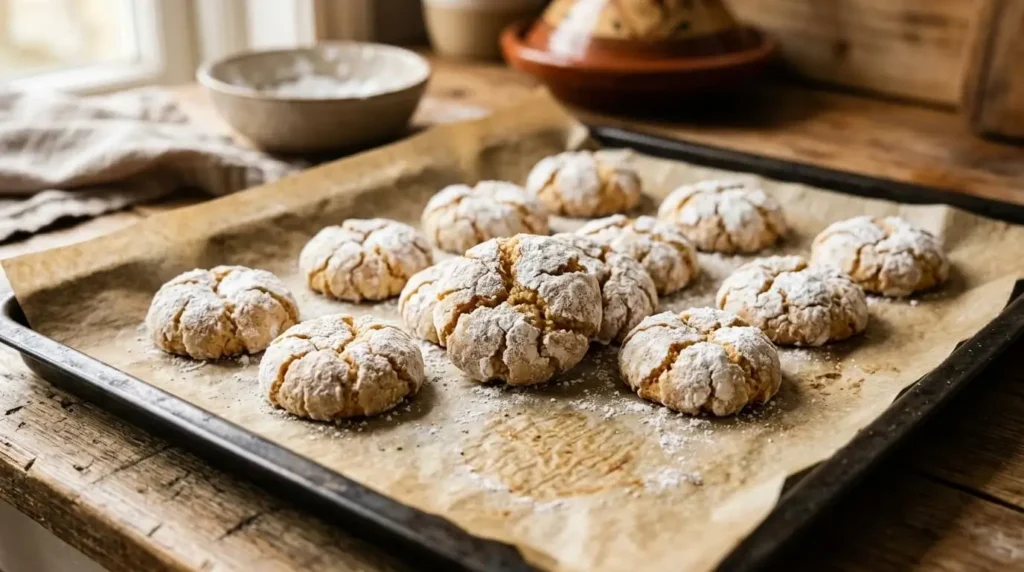
The crackled top and soft center both come from the same handful of variables, so it’s worth understanding how they interact. Because a well-hydrated dough and a thorough powdered-sugar coating give the surface something to crack against as the cookie sets. Therefore, oven temperature and timing matter just as much: too hot or too long and the whole cookie dries out before it can crack properly; too cool and the cookies may spread instead of holding their shape. Then cooling on the tray, rather than rushing straight to a cooling rack, gives the structure time to firm up without the cookies collapsing.
| Problem | Likely cause | Fix |
| Few or no cracks. | Coating too thin or oven temperature off. | Coat more generously; verify oven temperature with a thermometer. |
| Too dry. | Overbaked. | Pull the tray as soon as the base sets, before the centers look fully baked. |
| Excessive spreading. | Dough is too warm or too wet. | Chill or rest the dough briefly before shaping, if the tested method allows. |
| Powdered sugar disappears. | Coating too thin or dough too moist on the surface. | Roll each ball in sugar a second time before baking. |
| Fragile while hot. | Normal. | Let cookies cool on the tray before moving them. |
Moroccan Almond Cookies (Ghriba)
Ingredients
Method
Notes
- Texture: The cookies should be tender inside, not hard or dry.
- Almond flour: Fine blanched almond flour gives the cleanest appearance.
- Orange blossom water: Use a measured amount; too much can dominate.
- Powdered sugar: Coat thoroughly for the characteristic crackled appearance.
- Baking: Don’t judge doneness by firmness immediately out of the oven – the cookies firm up as they cool.
- Cooling: Allow cookies to set on the tray before moving them.
- Calories: ~90
- Carbohydrates: ~9g
- Protein: ~2g
- Fat: ~5g
- Saturated Fat: ~0.5g
- Fiber: ~1g
- Sugar: ~7g
- Sodium: ~15mg
Moroccan Almond Cookies: Traditional vs. Modern Adaptations
Almond ghriba recipes vary across households and regions and there isn’t one single “correct” version – the ghriba family includes recipes with different ratios of almonds to sugar, different levels of orange blossom water and different approaches to leavening. Furthermore, what’s more consistent is the general direction: an almond-forward dough, a distinctly Moroccan flavoring like orange blossom water and the crackled powdered-sugar finish. Because a US kitchen adaptation, using store-bought almond flour instead of freshly ground almonds, is a practical substitution rather than a lesser version – it’s a different starting point that can still land close to the traditional flavor profile.
| Traditional direction | Practical home-kitchen adaptation |
| Freshly ground blanched almonds and orange blossom water as a defining flavor. | Store-bought almond flour and orange blossom water used to taste. |
| Recipes vary by household; no single official formula. | One tested, consistent version suited to a US kitchen. |
Substitutions for US Home Cooks
Some ingredients in this recipe are easy to find at any US grocery store; a couple of others may require a trip to a Middle Eastern or specialty market. Therefore, knowing which substitutions preserve the cookie’s character – and which ones change it – makes shopping and baking easier.
Hard-to-Find Ingredients
Orange blossom water is the ingredient most likely to be unfamiliar; it’s sold at Middle Eastern grocers and some well-stocked supermarkets and there’s no substitute that tastes quite the same, though citrus zest gets closer than omitting it entirely. However, blanched almond flour is now widely available in the baking aisle of most US grocery stores, so substitution isn’t usually necessary there.
| Hard-to-find ingredient. | Where to find it | Substitute (if needed) |
| Orange blossom water. | Middle Eastern grocers, some supermarkets. | Citrus zest (different flavor). |
| Blanched almond flour. | Baking aisle of most supermarkets. | Grind blanched almonds finely at home. |
How to Store Moroccan Almond Cookies
Store cooled cookies in an airtight container at room temperature. According to the USDA Food Safety and Inspection Service, homemade or bakery cookies generally keep at room temperature for a couple of weeks when properly stored, with longer options in the refrigerator or freezer – general guidance, not testing specific to this recipe. But if freezing, let the cookies cool completely first and thaw them at room temperature before serving; texture may soften slightly after freezing compared to fresh.
How to Serve Moroccan Almond Cookies
The Traditional Pairing: Moroccan Mint Tea
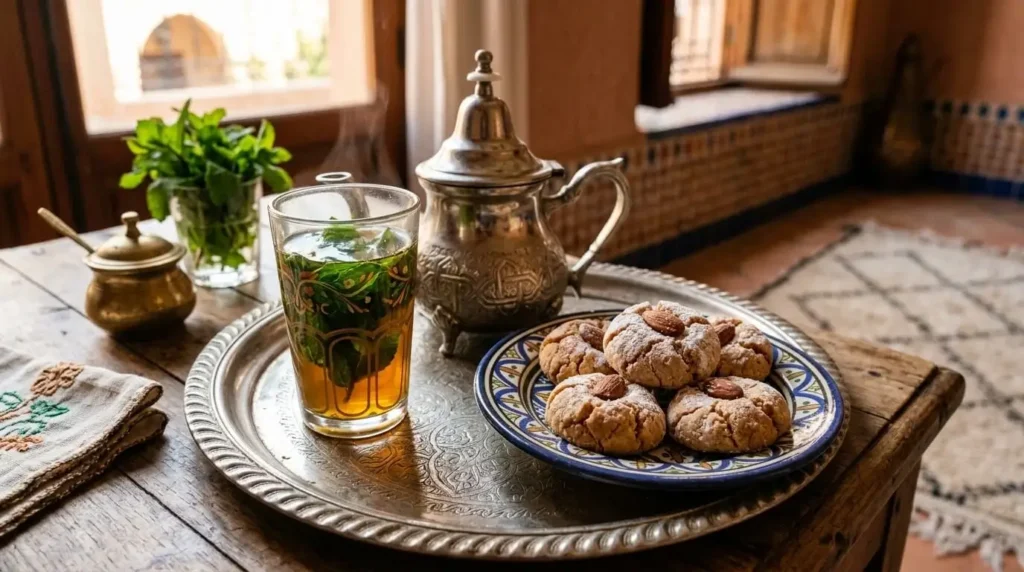
Almond ghriba is traditionally part of Moroccan tea time, served alongside Moroccan mint tea as part of the country’s broader culture of hospitality. Hence, according to the Moroccan National Tourist Office, ghriba is among the pastries commonly served with Moroccan mint tea and the Moroccan National Tourist Office’s guide to hospitality describes tea as a central part of welcoming guests.
Outside of that tradition, these cookies also work well with coffee or espresso or as part of a dessert platter – worth mentioning as options, but not traditional Moroccan pairings.
Troubleshooting Moroccan Almond Cookies
Why Didn’t My Cookies Crack?
This usually comes down to a thin sugar coating or an oven that’s running too hot or too cool. Also, coat the dough balls generously in powdered sugar and check your oven temperature with a separate thermometer if cracks aren’t forming consistently.
Why Are My Cookies Dry?
Dry, crumbly ghriba is almost always the result of overbaking. Then pull the tray as soon as the base and edges are set, even if the centers still look soft – they’ll continue to firm up as they cool.
Why Did They Spread?
Spreading usually means the dough was too warm or too soft when it went into the oven. But if your tested method includes a rest or chill, don’t skip it.
Why Are They Still Soft When They Come Out of the Oven?
This is expected. Because almond ghriba firms up considerably during cooling, judge doneness by the cracked, set exterior rather than by poking the center straight out of the oven.
Frequently Asked Questions
What are Moroccan almond cookies called?
They’re most often called almond ghriba or ghriba dyal louz. Because “ghriba” refers to a broader family of Moroccan cookies, almond ghriba is one specific version within that family, distinct from flour- or semolina-based ghriba.
What are Moroccan almond cookies made of?
The core ingredients are ground blanched almonds or almond flour, sugar, eggs and a Moroccan flavoring like orange blossom water or citrus zest. Hence, the dough is rolled in powdered sugar before baking, which forms the characteristic cracked crust.
What is ghriba?
“Ghriba” is a general name for a family of Moroccan cookies, not one single recipe. Also, depending on the household, ghriba can be made with almonds, semolina, flour, sesame or coconut, so recipes and textures vary widely under the same name.
How do you make Moroccan almond cookies?
Mix ground almonds with sugar, eggs and flavoring into a soft dough, portion it into balls, coat them thickly in powdered sugar and bake until the surface cracks while the center stays tender. Then, full quantities and timing are in the recipe card below.
Are Moroccan almond cookies gluten-free?
[FINAL TESTED VALUE REQUIRED: confirm once every ingredient and the baking environment are verified for cross-contact.] Furthermore, many almond ghriba recipes use no wheat flour, but that has to be confirmed against the actual finalized ingredient list before making a gluten-free claim.
Why do Moroccan almond cookies crack?
The cracks form as the dough expands slightly during baking and pushes against the powdered-sugar coating on the outside. Moreover, a generous coating and the right oven temperature are what allow those cracks to form cleanly rather than staying smooth.
Can I use almond meal instead of almond flour?
Almond meal is coarser and includes the almond skins, so it produces a denser, speckled cookie rather than the smooth, pale texture this recipe is built around. Therefore, it can work in a pinch, but expect a noticeably different result.
What do you serve with Moroccan almond cookies?
Moroccan mint tea is the traditional pairing and the one most tied to how these cookies are actually served in Morocco. Coffee, espresso or a dessert platter is a reasonable modern alternative, but they aren’t part of the traditional pairing.
[IMAGE 1: moroccan-almond-cookies-recipe-ghriba.jpg | Moroccan almond cookies ghriba served with mint tea | Moroccan Almond Cookies (Ghriba) | Tender, crackled Moroccan almond cookies served with Moroccan mint tea. | Hero image showing the finished Moroccan almond ghriba cookies and their traditional tea pairing.]
(Placed at the top of the article, below the H1/Quick Answer Box.)
[IMAGE 2: moroccan-almond-cookies-ingredients.jpg | Ingredients for Moroccan almond cookies recipe | Moroccan Almond Cookie Ingredients | The key ingredients for a fragrant almond-based Moroccan ghriba. | Ingredient overview emphasizing the almond base, orange blossom water and powdered-sugar coating.]
(Placed under “Ingredients for Moroccan Almond Cookies.”)
[IMAGE 3: shaping-moroccan-almond-ghriba.jpg | Shaping dough for Moroccan almond ghriba cookies | Shaping Moroccan Almond Ghriba | Shape the almond dough into small rounds before coating generously with powdered sugar. | Process image showing the dough texture and portioning stage before baking.]
(Placed under “3. Shape the Cookies.”)
[IMAGE 4: moroccan-almond-cookies-cracked-surface.jpg | Cracked surface on baked Moroccan almond cookies | The Signature Cracks on Moroccan Almond Cookies | The characteristic cracks are a feature of the cookie, not a baking mistake. | Close-up visual cue demonstrating the cracked powdered-sugar surface and proper baked appearance.]
(Placed under “How to Get the Signature Cracks and Tender Center.”)
[IMAGE 5: moroccan-almond-cookies-mint-tea.jpg | Moroccan almond cookies served with mint tea | Moroccan Almond Cookies with Mint Tea | Serve the almond ghriba with Moroccan mint tea for a classic tea-time pairing. | Serving image connecting the cookies with Morocco’s established tea and hospitality tradition.]
(Placed under “How to Serve Moroccan Almond Cookies.”)